
Vol. 4 (2026): There's No Place Like Home
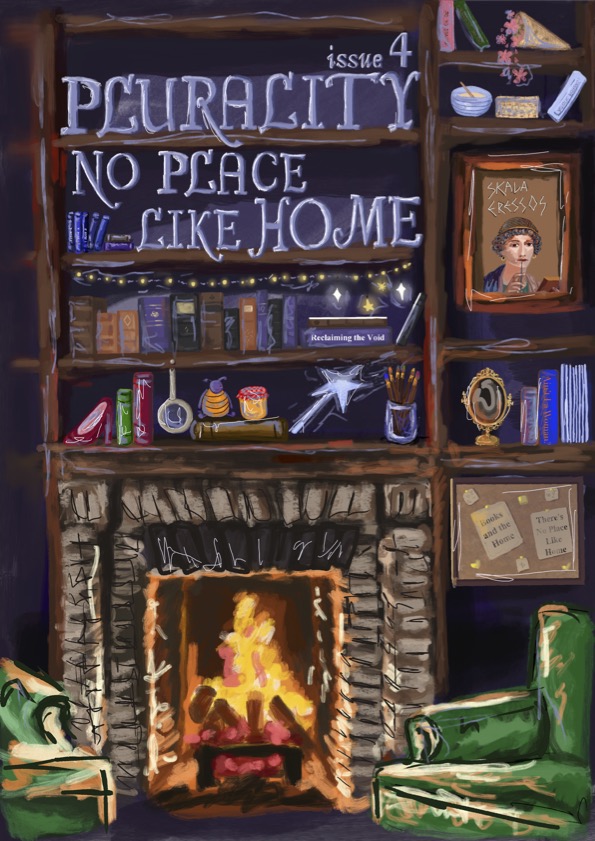
December 2025 marked Plurality’s second anniversary and was celebrated with new and old faces. I first became a part of the team as part of marketing, eager to be involved in a project that celebrates intersectional feminism, brings people together, and provides a space for undergraduate students to get involved with academia. Last spring, I was entrusted with the role of Lead Editor, succeeding Emmi Wilkinson, to continue to offer this space. Working with this journal has been an incredibly rewarding experience, one that has deepened my understanding of intersectional feminism and has allowed me to grow alongside my peers. As Plurality’s second Lead Editor, my goal is to foster a community grounded in collaboration, curiosity, and critical engagement, where undergraduate students feel supported in exploring complex ideas and contributing meaningfully to feminist scholarship.
“There’s No Place Like Home” was conceived by our Deputy Lead Editor, Rose Bates. This issue’s theme struck a chord for many, including myself, as “what is home?” and “where is home?” can be very complicated questions that facilitate many different answers. ‘Home’ not only means a place where someone lives but is also a feeling and an experience. Whether the discussion lies at home in the literal sense, in the domestic sphere, or the feeling of being ‘at home’ in one’s own body, or how the experience of home is something deeply political and socially constructed, this issue’s theme encouraged authors to explore the concept through an intersectional lens.
Issue 4 opens with our Philosophy and Divinity section, where Almundena Mahou deconstructs the novel Convenience Store Woman from the viewpoint of Japanese philosophy, arguing that the novel both evokes and challenges legacies of feminism and existentialism in Japan. In Art and Literature, Violet Blackburn employs a queer reading of the plays A Taste of Honey and Mrs Warren’s Profession, as both feature unconventional forms of gender, family units, and relationships. In another queer analysis, Andrea Cheng looks at two queer Chinese films to show how Western coming-out narratives are not always applicable to Chinese queer trajectories. Rounding up this section, we follow Dorothy down the yellow brick road in Kayla Greer’s exploration of domestic ideology in The Wizard of Oz. Kicking off our Social Sciences section, Annwen Thurlow examines everyday borders through the case study of two women footballers to demonstrate the intersections of racial governmentality and hegemonic ideals of femininity. Sommer Lugert, a two-time published author for Plurality, uses a feminist lens to examine how home and belonging are produced, negotiated, and contested in the lives of autistic mothers. We then turn the page to History and Classics, where Cerys Jones looks at how reading functions as a means of asserting personal autonomy and individuality for interwar and postwar women, and Molly Ebdy draws attention to the various roles of women in the colonisation and resistance on the American Frontier. In Miscellaneous Musings, Apsara Shah combs through the ideas of androgyny and how gendered appearance can impact how we perceive ourselves and others. Bringing us home is Rita Merle Destremau, who uses an intersectional lens to discuss the power and colonisation perpetuated by homosexual women on the island of Lesbos, and asks if there is a home for lesbians.
This issue would not have been made possible without the contributions of these brilliant authors and the hard work of the Plurality team. Thank you to the artists Elise Adams, Rosy Fitch, and Madeleine Brady, who worked across artistic media to create the stunning cover and in-text illustrations, making the idea visually come to life. Thanks to our Head of Production, Khoo Yi Xuan, for collaborating and coordinating across the team to put these beautiful pages together. To section editors Zeynep Kilic and Helena Osie Bishop, for continuing to work with Plurality over the past two years, and Asher Rose, Ruby Scott, and Poppy Williams, for joining them in working closely with the authors to help create the pieces that we have today. This issue would not be up to its editorial standard if it were not for our copy editors, Lauren Hood, Juliette Pepin, and Layla Kaban Bowers. And our outreach team, Daniel Wills and Maeve Burrell, for spreading the word of Plurality to reach authors and readers alike. Last but not least, thank you so much to my fellow executives, Rose Bates and Neha Ajith; this issue would not have been made possible without your support and leadership.
As this chapter closes, another one begins with our upcoming issue, “The Natural”. In a world increasingly shaped by bioessentialism, climate change, and artificial intelligence, I encourage authors to ask themselves: what do we consider to be ‘natural’? How has this idea been embedded within our social structures, institutions, dominant ideologies, and even our understanding of time? What can we learn about the natural world and from our evolving relationship to it that might help us reimagine the present and future? ‘Natural’ logics play into everything from how we understand gender and power, to how we value bodies, organise society, relate to the environment, and even in defining beauty. These concepts do not exist in a vacuum but are rather shaped by history, culture and power. I hope this theme inspires authors to explore ‘The Natural’ through an intersectional lens and that Plurality can continue to offer a space for reflection and reimagining.
In the meantime, I hope you enjoy Issue 4: “There’s No Place Like Home”.