
Vol. 5 (2026): The Natural
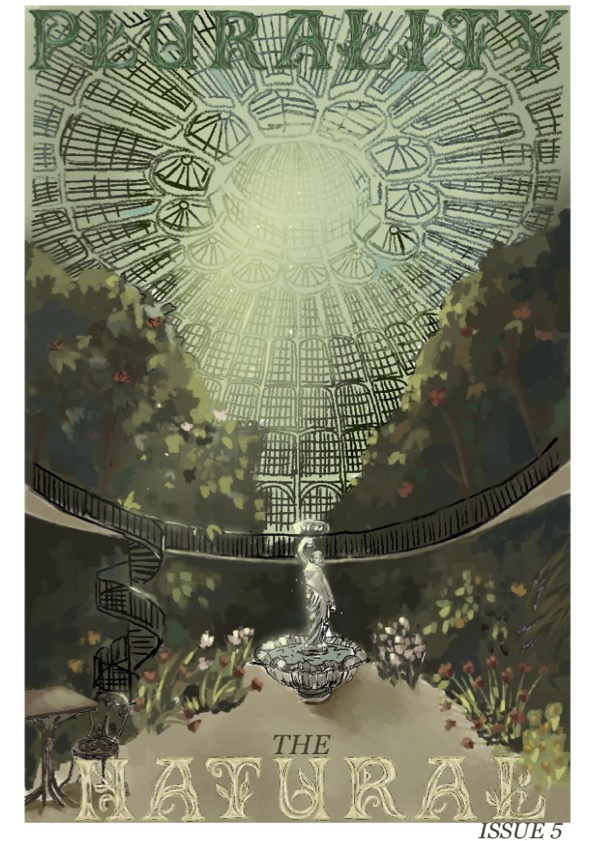
We often take for granted what we consider to be “natural”, often forgetting how such constructions are heavily shaped by our environments, perspectives, and positionality. How we understand history, culture, gender, race, and power cannot be understood in a vacuum, and thus require careful inspection. What is “natural”? And what do we consider to be “unnatural”? These are the questions that sit at the heart of Issue 5, collectively conceptualised by the Plurality team. This issue’s theme was intentionally made to be broad so to invite a range of interpretations, analyses, and reflections from our authors.
Against the natural order (and perhaps in spirit of it), this issue begins with the Art and Literature section. Here, Saanvi Sinha dives into an exploration of the fragmented self through Igbo cosmology in Nigerian writer Akwaeke Emezi’s Freshwater. Ellie Sutherland then employs a queer lens in the analysis of Frances Ha to argue that growing up is not naturally linear. Turning now to History and Classics, Conger Wang reimagines the landscape of the American West to argue that enclosure and agricultural improvement naturalised inequality. In Emma Stinchon’s piece, contemporary Western notions of the naturalised cisgender body are challenged by unearthing the historical presence of diverse gender expressions. Rounding up this section, Isabelle Davies traces the origins and developments of emotional historiography to demonstrate how emotions are historically situated, rooted in power, and heavily impacted by Western ideas. Tending to our Philosophy and Divinity section is Zhuyuyue Gao, who challenges posthumanist theories of subjectivity through the work of the performance artist Cassil. In Social Sciences, Mia Hutchins argues that while the 4B movement in South Korea challenges natural gender norms, its efficiency does not translate globally. We then branch into Marlene Ito’s piece, who, through three case studies examine the shared logic of a racialised othering. Coming to a close with Tara Laize, who unearths how Indigenous women are constructed as hypersexualised through the intersecting forces of gender, race, and empire within the colonial order.
I would like to express my gratitude to our authors for contributing their time and labour into this issue, Plurality would not be possible without your brilliance. To the Plurality team, thank you for going above and beyond – your efforts have allowed this journal to grow and flourish! Khoo Yi Xuan, our Head of Production, thank you for curating these wonderful pages, ensuring that they flow with cohesion, and for collaborating closely with our Artists, Elise Adams, Rosy Fitch, and Madeleine Brady, who created the gorgeous artwork for this issue. Thank you to Section Editors, Zeynep Kilic, Ruby Scott, Poppy Williams, and Asher Rose for supporting our authors in editing their work, and to Helena Osie Bishop, for lending her expertise to our editorial team and providing support. To Juliette Pepin, Lauren Hood, and Layla Kaban Bowers, the Copy Editors whose attention to detail ensures that Plurality meets editorial standards, and to our Peer reviewers for lending their expertise and time to review our authors’ work. Thanks to the Outreach Team, Daniel Wills and Maeve Burrell, who continue to sow our seeds by organising events and tending to our socials. And finally, to Deputy Lead Editor Rose Bates and Treasurer-Secretary Neha Ajith, I am eternally grateful for your patience, resilience, and friendship. I have wholeheartedly enjoyed and appreciated my time as Lead Editor for Plurality, even in its most challenging moments, and especially in its most rewarding ones – in collaborating with authors and teammates alike to publish important undergraduate work, broadening my horizons as an intersectional feminist, and growing as an individual.
As Plurality enters a new season, I am thrilled to announce Neha Ajith as my successor, in whom I have every confidence she will do amazing things for this journal and ensure it continues to bloom. Neha will oversee some exciting changes that the current team and I have democratically agreed upon: we will no longer have sections, and Plurality aims to become a society at the University of Edinburgh. In the spirit of stepping out from what has felt natural to the journal, we hope that the removal of sections will allow us to branch out and not restrict submissions to predefined categories. Further, our societal status will not alter our ethos, namely, to publish undergraduate research in intersectional feminism and remaining open-access and accessible to everyone but will allow us to set down roots within the university community.
I wish the best of luck to Neha and the new committee and thank you all for this fantastic year!
Warm Regards,
Emilia Manning-Gaona