Skills, scaling, and the role of youngsters in adaptation during the Northern European Final Palaeolithic
DOI:
https://doi.org/10.2218/jls.10853Palabras clave:
flint; children; Final Palaeolithic; knapping; skillResumen
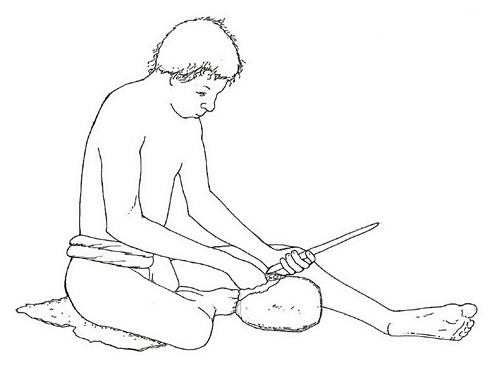
At any one time in the Palaeolithic, children constituted the largest group of individuals in a given community. While not many objects ascribed to children are known from these remote periods, it is beyond doubt that children participated in many aspects of daily life, including knapping. These youngsters played a vital role in generating technological variation and in societal adaptation. We here focus on the role of children in Northern European Final Palaeolithic societies that experienced markedly different climatic regimes in order to better understand how youngsters and their playful, exploratory learning may have contributed to adaptation. Using a mixed-methods approach we study inexperienced knappers with emphasis on three distinct groups of flintwork: blades, cores, and projectile points. We apply 2D geometric morphometrics coupled with technological attributes, quantitative and qualitative analyses to interrogate the variability within these groups with the aim of tracing the possible work of children through notions of skill level and artefact scaling. The purpose of this analysis is to investigate (i) how we can identify the signatures of children knapping flint, and (ii) how children’s participation in flintwork varied between inventories from periods characterised by distinctly different climates. Finally, to better understand the role of children in innovation and adaptation, we discuss how children’s knapping relates to the generation of technological variability, innovation, and differences in adaptation. The combined analytical focus on blades, points and cores allow us to more securely identify evidence for children, allowing us to compare their contributions to cultural variability across the two time periods.
Referencias
References
Aaris-Sørensen, K., Mühldorff, R. & Petersen, E.B. 2007, The Scandinavian reindeer (Rangifer tarandus L.) after the last glacial maximum: time, seasonality and human exploitation. Journal of Archaeological Science, 34(6): 914-923. DOI: https://doi.org/10.1016/j.jas.2006.09.014
Apel, J. 2001, Daggers, Knowledge and Power: The Social Aspect of Flintdagger Technology in Scandinavia 2350-1500 cal BC. Coast to Coast 3, Uppsala, 364 p.
Assaf, E. 2021a, Dawn of a new day: The role of children in the assimilation of new technologies throughout the Lower Paleolithic. L'Anthropologie, 125(1): 102836. DOI: https://doi.org/10.1016/j.anthro.2021.102836
Assaf, E. 2021b, Throughout the generations: Learning processes and knowledge transmission mechanisms as reflected in lithic assemblages of the terminal Lower Paleolithic Levant. Journal of Archaeological Science: Reports, 35: 102772. DOI: https://doi.org/10.1016/j.jasrep.2020.102772
Assaf, E., Barkai, R. & Gopher, A. 2016, Knowledge transmission and apprentice flint-knappers in the Acheulo-Yabrudian: A case study from Qesem Cave, Israel. Quaternary International, 398: 70-85. DOI: https://doi.org/10.1016/j.quaint.2015.02.028
Assaf, E., Nunziante-Cesaro, S., Gopher, A. & Venditti, F. 2022, Learning by Doing: Investigating Skill Through Techno-Functional Study of Recycled Lithic Items from Qesem Cave (Israel). Journal of Archaeological Method and Theory. DOI: https://doi.org/10.1007/s10816-022-09590-6
Audouze, F. & Cattin, M.-I. 2011, Flint Wealth versus Scarcity: Consequences for Magdalenian Apprentices hip. Lithic Technology, 36(2): 109-126. DOI: https://doi.org/10.1179/lit.2011.36.2.109
Augereau, A. 2019, Change and continuity: Gender and flint knapping activities during the Neolithic in the Paris basin. In: Gender Transformations in Prehistoric and Archaic Societies (Koch, J.K. & Kirleis, W., Eds.), Scales of Transformation: Human-Environmental Interaction in Prehistor ic and Archaic Societies Vol. 6, Sidestone Press, Leiden: p. 435-458. URL: https://hal.science/hal-03361469v1
Baena, J., Ortiz, I. & Torres, C. 2019, Good and Bad Knappers among Neanderthals. In: Learning among Neanderthals and Palaeolithic Modern Humans. Archaeological Evidence (Nishiaki, Y. & Jöris, O., Eds.), Replacement of Neanderthals by Modern Humans Series, Springer Nature, Singapore: p. 95-117. DOI: https://doi.org/10.1007/978-981-13-8980-1_7
Ballin, T.B. 1991, Højgård. Flintsammensætningens Teori og Metode Belyst gennem en Konkret Analyse. Master's thesis, Aarhus University, Moesgård, 83 p. (in Danish) ("Højgård. The Theory and Method of Flint Composition Illuminated through a Concrete Analysis ")
Bamforth, D.B. & Finlay, N. 2008, Introduction: Archaeological approaches to lithic production skill and craft learning. Introduction: Archaeological approaches to lithic production skill and craft learning, 15(1): 1-27. DOI: https://doi.org/10.1007/s10816-007-9043-3
De Bie, M. & Caspar, J.-P. 2000, Rekem - A Federmesser Camp on the Meuse River Bank. Vol. 1 & 2. Acta Archaeologica Lovaniensia Vol. 10. Leuven University Press, Leuven, 235 + 261 p.
De Bie, M. & Vermeersch, P.M. 1998, Pleistocene–Holocene Transition in Benelux. Quaternary International, 49-50: 29-43. DOI: https://doi.org/10.1016/s1040-6182(97)00052-9
Bodu, P. 1990, L’Application de la Méthode des Remontages à l’Étude du Matériel Lithi que des Premiers Niveaux Châtelperroniens de la Grotte du Renne à Arcy-sur-Cure (Yonne). In: Paleolithique Moyen Recent et Paleolithique Superieur Ancien en Europe (Farizy, C., Ed.), Mémoires du Musée de Préhistoire d'Ile-de-France Vol. 3, APRAIF, Nemours: p. 309-312. (in French) ("The Application of the Reassembly Method to the Study of Lithic Material from the First Châtelperronian Levels of the Grotte du Renne in Arcy-sur Cure (Yonne)")
Bodu, P., Karlin, C. & Ploux, S. 1990, Who’s who? The Magdalenian Flintknappers of Pincevent, France. In: The big puzzle: International Symposium on Refitting Stone Artefacts, Monrepos, 1987 (Cziesla, E., Eickhoff, S., Arts, N. & Winter, D., Eds.), Studies in Modern Archaeology Vol. 1, Holos Verlag, Bonn: p. 143-163.
Bogin, B. 2006, Modern Human Life History. The Evolution of Human Childhood and Adult Fertility. In: The Evolution of Human Life History (Hawkes, K. & Paine, R.R., Eds.), School of American Research Press, Santa Fe, New Mexico: p. 197-230. URL: http://grammar.ucsd.edu/courses/hdp1/Readings/BOGIN_SAR.pdf
Bokelmann, K. 1991, Some New Thoughts on Old Data on Humans and Reindeer in the Ahrensburg Tunnel Valley in Schleswig-Holstein, Germany. In: Late Glacial in North-West Europe: Human Adaptation and Environmental Change at the End of the Pleistocene (Barton, N., Roberts, A.J. & Roe, D.A., Eds.), CBA Research Report Vol. 77, Council for British Archaeology, London: p. 72-81.
Bratlund, B. 1991, A Study of Hunting Lesions Containing Flint Fragments on Reindeer Bones at Stellmoor, Schleswig-Holstein, Germany. In: Late Glacial in North-West Europe: Human Adaptation and Environmental Change at the End of the Pleistocene (Barton, N., Roberts, A.J. & Roe, D.A., Eds.), CBA Research Reports Vol. 77, Council for British Archaeology, London: p. 193-207.
Castañeda, N. 2018, Apprenticeship in Early Neolithic Societies: The Transmission of Technological Knowledge at the Flint Mine of Casa Montero (Madrid, Spain), ca. 5300–5200 cal BC. Current Anthropology, 59(6): 716-740. DOI: https://doi.org/10.1086/700837
Cattabriga, G., Gramigna, A. & Peresani, M. 2024, Exploring Knapping Learning Processes Amongst Upper Palaeolithic Hunter-Gatherers. History of Education, 53(3): 439-459. DOI: https://doi.org/10.1080/0046760x.2023.2223545
Cattabriga, G. & Peresani, M. 2024, Criteria for Identifying Knapping Skill Level Through the Analysis of Lithic Cores: An Example from Val Lastari, Late Palaeolithic, Italy. Lithic Technology, 49(4): 416-431. DOI: https://doi.org/10.1080/01977261.2024.2303230
Centi, L., Valletta, F. & Zaidner, Y. 2023, To Err Is Human: Knapping Expertise and Technological Variability at the Middle Palaeolithic Site of Nesher Ramla, Israel. Journal of Archaeological Method and Theory, 30: 103-126. DOI: https://doi.org/10.1007/s10816-022-09594-2
Cunnar, G.E. 2015, Discovering Latent Children in the Archaeological Record of the Great Basin. Childhood in the Past, 8(2): 133-148. DOI: https://doi.org/10.1179/1758571615z.00000000035
Darmark, K. 2010, Measuring skill in the production of bifacial pressure flaked points: a multivariate approach using the flip-test. Journal of Archaeological Science, 37(9): 2308-2315. DOI: https://doi.org/10.1016/j.jas.2010.04.004
Donahue, R.E. & Fischer, A. 2015, A Late Glacial family at Trollesgave, Denmark. Journal of Archaeological Science, 54: 313-324. DOI: https://doi.org/10.1016/j.jas.2014.12.018
Dugstad, S.A. 2010, Early Child Caught Knapping. A Novice Early Mesolithic Flintknapper in South-Western Norway. AmS-Skrifter, 23: 65-74. URL: https://www.academia.edu/19663912/
Eren, M.I., Bradley, B.A. & Sampson, C.G. 2011, Middle Paleolithic Skill Level and the Individual Knapper: An Experiment. American Antiquity, 76(2): 229-251. DOI: https://doi.org/10.7183/0002-7316.76.2.229
Ferguson, J.R. 2003, An Experimental Test of the Conservation of Raw Material in Flintknapping Skill Acquisition. Lithic Technology, 28(2): 113-131. DOI: https://doi.org/10.1080/01977261.2003.11721007
Ferguson, J.R. 2008, The when, where, and how of novices in craft production. Journal of Archaeological Method and Theory, 15(1): 51-67. DOI: https://doi.org/10.1007/s10816-007-9047-z
Finlay, N. 1997, Kid knapping: the missing children in lithic analysis. In: Invisible People and Processes: Writing Gender and Childhood into Euro pean Archaeology (Moore, J. & Scott, E., Eds.), Leicester University Press, Leicester: p. 203-213.
Finlay, N. 2008, Blank concerns: Issues of skill and consistency in the replication of scottish later Mesolithic blades. Journal of Archaeological Method and Theory, 15(1): 68-90. DOI: https://doi.org/10.1007/s10816-007-9048-y
Finlay, N. 2015, Kid-knapped Knowledge: Changing Perspectives on the Child in Lithic Studies. Childhood in the Past, 8(2): 104-112. DOI: https://doi.org/10.1179/1758571615z.00000000032
Fischer, A. 1988, A Late Palaeolithic Flint Workshop at Egtved, East Jutland: A Glimpse of the Federmesser Culture in Denmark. Journal of Danish Archaeology, 7(1): 7-23. DOI: https://doi.org/10.1080/0108464x.1988.10589994
Fischer, A. 1990a, A Late Palaeolithic 'School' of flint-knapping at Trollesgave, Denmark: Results from refitting. Acta Archaeologica, 60: 33-49. URL: https://www.academia.edu/37537401/
Fischer, A. 1990b, On Being a Pupil of a Flintknapper of 11,000 Years Ago: A Preliminary Analysis of Settlement Organization and Flint Technology Based on Conjoined Flint Artefacts from the Trollesgave Site. In: The Big Puzzle: International Symposium on Refitting Stone Artefacts, Monrepos, 1987 Vol. 1 (Cziesla, E., Eickhoff, S., Arts, N. & Winther, D., Eds.), Studies in Modern Archaeology, Holos Verlag, Bonn: p. 447-464. URL: https://www.researchgate.net/publication/306203687
Fischer, A. & Nielsen, F.O.S. 1987, Senistidens Bopladser ved Bromme. En Genbearbejdning af Westerby's og Mathiassen's Fund. Aarbøger for Nordisk Oldkyndighed og Historie, 1986: 5-42. (in Danish) ("Late Ice Age Settlements at Bromme. A Reworking of Westerby's and Mathiassen's Finds ") URL: https://www.researchgate.net/publication/277302411
Flas, D. 2014, Northern Europe: Middle to Upper Paleolithic Transition. In: Encyclopedia of Global Archaeology (Smith, C., Ed.), Springer New York, New York: p. 5499-5514. DOI: https://doi.org/10.1007/978-3-030-30018-0_1854
French, J.C. 2021, Palaeolithic Europe: a Demographic and Social Prehistory. Cambridge University Press, Cambridge, 332 p.
Geribàs, N., Mosquera, M. & Vergès, J.M. 2010, What novice knappers have to learn to become expert stone toolmakers. Journal of Archaeological Science, 37(11): 2857-2870. DOI: https://doi.org/10.1016/j.jas.2010.06.026
Goldstein, S.T. 2018, Knowledge Transmission Through the Lens of Lithic Production: a Case Study from the Pastoral Neolithic of Southern Kenya. Journal of Archaeological Method and Theory, 26(2): 679-713. DOI: https://doi.org/10.1007/s10816-018-9387-x
Gómez Coutouly, Y.A., Gore, A.K., Holmes, C.E., Graf, K.E. & Goebel, T. 2020, “Knapping, My Child, is Made of Errors”: Apprentice Knappers at Swan Point and Little Panguingue Creek, Two Prehistoric Sites in Central Alaska. Lithic Technology, 46(1): 2-26. DOI: https://doi.org/10.1080/01977261.2020.1805201
Gopnik, A. 2020, Childhood as a solution to explore-exploit tensions. Philosophical Transactions of the Royal Society B: Biological Sciences, 375(1803): 20190502. DOI: https://doi.org/10.1098/rstb.2019.0502
Grimm, L. 2000, Apprentice flintknapping. Relating material culture and social practice in the Upper Palaeolithic. In: Children and Material Culture (Derevenski, J.S., Ed.), Routledge, London: p. 53-71. URL: https://www.taylorfrancis.com/chapters/edit/10.4324/9780203991862-14/
Grimm, S.B. & Weber, M.-J. 2008, The Chronological Framework of the Hamburgian in the Light of Old and New 14C Dates. Quartär. International Yearbook for Ice Age and Stone Age Research, 55: 17-40. DOI: https://doi.org/10.7485/qu55_02
Grønnow, B. 1985, Meiendorf and Stellmoor Revisited : An Analysis of Late Palaeolithic Reindeer Exploitation. Acta Archaeologica, 56: 131-166. URL: https://actaarchaeologica.eu/acta_search/article/?action=getpdf&volumeno=56&ArticleID=AA56.6&showpdf=1
Hikade, T. 2005, How to pass on the skill of flint knapping: Two flint knives from Helwan. Bulletin of the Australian Centre for Egyptology, 16: 29-33. URL: http://www.egyptology.mq.edu.au/Contents_BACE_1-16.htm
Högberg, A. 1999, Child and Adult at a Knapping Area: A Technological Flake Analysis of the Manufacture of a Neolithic Square Sectioned Axe and a Child's Flintknapping Activities on an Assemblage Excavated as Part of the Öresund Fixed Link Project. Acta Archaeologica, 70: 79-106. URL: https://actaarchaeologica.eu/acta_search/article/?action=getpdf&volumeno=70&ArticleID=AA70.4&showpdf=1
Högberg, A. 2008, Playing with Flint: Tracing a Child’s Imitation of Adult Work in a Lithic Assemblage. Journal of Archaeological Method and Theory, 15(1): 112-131. DOI: https://doi.org/10.1007/s10816-007-9050-4
Holm, J. & Rieck, F. 1992, Istidsjægere ved Jelssøerne: Hamburgkulturen i Danmark. Skrifter fra Museumsrådet for Sønderjyllands Amt Vol. 5. Haderslev Museum, Haderslev, 151 p. (in Danish) ("Ice Age Hunters at the Jels Lakes: The Hamburg Culture in Denmark ")
Hovers, E. 2009, Learning from Mistakes: Flaking Accidents and Knapping Skills in the Assemblage of A. L. 894 (Hadar, Ethiopia). In: The Cutting Edge: New Approaches to the Archaeology of Human Origin (Schick, K.D. & Toth, N., Eds.), Stone Age Institute Publication Series, Stone Age Institute Press, Gosport: p. 137-150. URL: https://www.academia.edu/223088/
Johansen, L. & Stapert, D. 2004, Oldeholtwolde. A Hamburgian Family Encampment around a Hearth. Aa Balkema Publishers, Lisse, 229 p.
Karlin, C. & Julien, M. 1994, Prehistoric Technology: A Cognitive Science? In: The Ancient Mind: Elements of Cognitive Archaeology (Renfrew, C. & Zubrow, E.B.W., Eds.), New Directions in Archaeology, Cambridge University Press, Cambridge: p. 152-164.
Klaric, L. 2018, Levels of flintknapping expertise and apprenticeship during the Mid-Upper Palaeolithic: Several illustrative examples from the Early and Late Aurignacian and Middle Gravettian. In: The Prehistoric Apprentice. Investigating Apprenticeship, Know-How and Expertise in Prehistoric Technologies / / L'Apprenti Préhistorique: Appréhender l’Apprentissage, les Savoir-Faire et l’Expertise à Travers les Productions Techniques des Sociétés Préhistoriques Vol. 24 (Klaric, L., Ed.), Dolnověstonické Studie, The Czech Academy of Sciences, Institute of Archaeology, Brno: p. 49-115. URL: https://www.academia.edu/44307785/
Knight, C.L.F. 2017, Children, apprenticeship and pedagogy: Domestic crafting and obsidian core production at the Zaragoza-Oyameles source area in Puebla, Mexico. Journal of Anthropological Archaeology, 47: 152-166. DOI: https://doi.org/10.1016/j.jaa.2017.02.003
Knutsson, K. 1983, Barn, Finns Dom? Fjölnir, 2(1): 8-11. (in Swedish) ("Children, do they exist?")
Knutsson, K. 1986, Några Ord om Barn, Stötkantkärnor och Pieces Esquillées. Fjölnir, 5(1): 29-39. (in Swedish) ("A Few Words About Children, Bumper Cores, and the Esquillées Pieces ")
Kotthaus, J.K. 2019, The Federmesser site of Borneck-Ost, Ahrensburg tunnel valley: Revised results and new perspectives following a re-analysis of the lithic material. In: The Final Palaeolithic of Northern Eurasia: Proceedings of the Amersfoort, Schleswig and Burgos UISPP Commission Meetings (Eriksen, B.V., Rensink, E. & Harris, S., Eds.), Kiel, Ludwig: p. 193-207. URL: https://www.academia.edu/41680131/
Krüger, S., Mortensen, M.F. & Dörfler, W. 2020, Sequence completed – palynological investigations on Lateglacial/Early Holocene environmental changes recorded in sequentially laminated lacustrine sediments of the Nahe palaeolake in Schleswig-Holstein, Germany. Review of Palaeobotany and Palynology, 280: 104271. DOI: https://doi.org/10.1016/j.revpalbo.2020.104271
Langley, M.C. 2018, Magdalenian Children: Projectile Points, Portable Art and Playthings. Oxford Journal of Archaeology, 37(1): 3-24. DOI: https://doi.org/10.1111/ojoa.12128
Leca, J.-B. & Gunst, N. 2023, The exaptive potential of (object) play behavior. International Journal of Play, 12(1): 40-52. DOI: https://doi.org/10.1080/21594937.2022.2152184
Leroyer, M. 2018, Identifying Different Skill Levels in the Lower Palaeolithic: Master and Apprentice Biface Knappers at Boxgrove (England). In: The Prehistoric Apprentice. Investigating Apprenticeship, Know-How and Expertise in Prehistoric Technologies / / L'Apprenti Préhistorique: A ppréhender l’Apprentissage, les Savoir-Faire et l’Expertise à Travers les Productions Techniques des Sociétés Préhistoriques Vol. 24 (Klaric, L., Ed.), Dolnověstonické Studie, The Czech Academy of Sciences, Institute of Archaeology, Brno: p. 23-47.
Lew-Levy, S. & Amir, D. 2024, Children as agents of cultural adaptation. Behavioral and Brain Sciences: 1-68. DOI: https://doi.org/10.1017/S0140525X24001377
Lew-Levy, S., Bos, W., Corriveau, K., Dutra, N., Flynn, E., O'Sullivan, E., Pope-Caldwell, S., Rawlings, B., Smolla, M., Xu, J. & Wood, L. 2023, Peer learning and cultural evolution. Child Development Perspectives, 17(2): 97-105. DOI: https://doi.org/10.1111/cdep.12482
Mathiassen, T. 1946, En Senglacial Boplads ved Bromme. Aarbøger for Nordisk Oldkyndighed og Historie, 1946(2): 121-197. (in Danish) ("A Late Glacial Settlement at Bromme ")
Milks, A., Lehman, J., Leder, D., Sietz, M., Koddenberg, T., Böhner, U., Wachtendorf, V. & Terberger, T. 2023, A double-pointed wooden throwing stick from Schoningen, Germany: Results and new insights from a multianalytical study. PLoS One, 18(7): e0287719. DOI: https://doi.org/10.1371/journal.pone.0287719
Milne, S.B. 2005, Palaeo-Eskimo novice flintknapping in the eastern Canadian Arctic. Journal of Field Archaeology, 30(3): 329-345. DOI: https://doi.org/10.1179/009346905791072224
Milne, S.B. 2012, Lithic Raw Material Availability and Palaeo-Eskimo Novice Flintknapping. In: Archaeology and Apprenticeship, Body Knowledge, Identity, and Communities of Practice (Wendrich, W., Ed.), University of Arizona Press, Tucson: p. 119-144.
Mithen, S. & Finlay, N. 1993, Testpit Survey and Trial Excavation at Coulererarch. In: The Southern Hebrides Mesolithic Project, 6th Interim Report, Reading University, Reading.
Mortensen, M.F., Birks, H.H., Christensen, C., Holm, J., Noe-Nygaard, N., Odgaard, B.V., Olsen, J. & Rasmussen, K.L. 2011, Lateglacial vegetation development in Denmark – New evidence based on macrofossils and pollen from Slotseng, a small-scale site in southern Jutland. Quaternary Science Reviews, 30(19-20): 2534-2550. DOI: https://doi.org/10.1016/j.quascirev.2011.04.018
Mugaj, J. 2015, Lithic Technology and Spatial Structures of the Camp as Seen in Lithic Refittings from Hamburgian Site at Mirkowice. Sprawozdania Archeologiczne, 67: 23-29. URL: https://www.rcin.org.pl/Content/57797/
Neubauer, F. 2018, Playing with Projectile Points: Childhood Flintknapping Imitation at a n 8,500-year-old Hunter-Gatherer Rockshelter Site in Southern Brazil. Revista de Arqueologia, 31(2 - Arqueologia da Infância): 35-57. DOI: https://doi.org/10.24885/SAB.V31I2.586
Nowell, A. 2015, Children, Metaphorical Thinking and Upper Paleolithic Visual Cultures. Childhood in the Past, 8(2): 122-132. DOI: https://doi.org/10.1179/1758571615z.00000000034
Nowell, A. 2021, Growing Up in the Ice Age: Fossil and Archaeological Evidence of the Lived Lives of Plio-Pleistocene Children. Oxbow Books, Oxford, 384 p. DOI: https://doi.org/10.2307/j.ctv13nb8xw
Pargeter, J., Liu, C., Kilgore, M.B., Majoe, A. & Stout, D. 2023, Testing the Effect of Learning Conditions and Individual Motor/Cognitive Differences on Knapping Skill Acquisition. Journal of Archaeological Method and Theory, 30: 127-171. DOI: https://doi.org/10.1007/s10816-022-09592-4
Pedersen, J.B., Assmann, J.J., Normand, S., Karger, D.N. & Riede, F. 2023, Climate Niche Modeling Reveals the Fate of Pioneering Late Pleistocene Populations in Northern Europe. Current Anthropology, 64(5): 599-608. DOI: https://doi.org/10.1086/726700
Pedersen, J.B., Maier, A. & Riede, F. 2018, A Punctuated Model for the Colonisation of the Late Glacial Margins of Northern Europe by Hamburgian Hunter-Gatherers. Quartär. International Yearbook for Ice Age and Stone Age Research, (65): 85-104. DOI: https://doi.org/10.7485/qu65_4
Pedersen, J.B., Poulsen, M.E. & Riede, F. 2022, Jels 3, a New Late Palaeolithic Open-Air Site in Denmark, Sheds Light on the Pioneer Colonization of Northern Europe. Journal of Field Archaeology, 47(6): 360-378. DOI: https://doi.org/10.1080/00934690.2022.2086346
Pellegrini, A.D. 2013, Object use in childhood: development and possible functions. Behaviour, 150(8): 813-843. DOI: https://doi.org/10.1163/1568539X-00003086
Pigeot, N. 1987, Magdaléniens d'Étiolles. Économie de Débitage et Organisation Sociale (l'Uunité d'Habitation U5). Vol. 25. Gallia Préhistoire Vol. Supplément A, 168 p. (in French) ("Magdalenians at Étiolles. Economy of Debitage and Social Organization (Housing Unit U5)") URL: https://www.persee.fr/doc/galip_0072-0100_1987_sup_25_1
Pigeot, N. 1990, Technical and Social Actors: Flintknapping Specialists and Apprentices at Magdalenian Etiolles. Archaeological Review from Cambridge, 9(1): 126-141. URL: https://arc.soc.srcf.net/issues/9-1
Ploux, S. 1984, Étude de Débitages Archéologiques et Expérimentaux: La Marque du Tailleur. In: Économie du Débitage Laminaire: IIIéme Table-Ronde de Technologie Lithique, Préhistoire de la Pierre Taillée Vol. 2, CREP, Paris: p. 45-51. (in French) ("Study of Archaeological and Experimental Debitage: The Mark of the Knapper ")
Ploux, S. 1989, Approche Archéologique de la Variabilité des Comportements Techniques Individuels: L’Exemple de Quelques Tailleurs Magdaléniens à Pincevent. PhD thesis, Université Paris X, Nanterre, 378 p. (in French) ("Archaeological Approach to the Variability of Individual Technical Behaviours: The Example of some Magdalenian Stonemasons at Pincevent ") URL: https://theses.hal.science/tel-00761111/
Rasmussen, S.O., Bigler, M., Blockley, S.P., Blunier, T., Buchardt, S.L., Clausen, H.B., Cvijanovic, I., Dahl-Jensen, D., Johnsen, S.J., Fischer, H., Gkinis, V., Guillevic, M., Hoek, W.Z., Lowe, J.J., Pedro, J.B., Popp, T., Seierstad, I.K., Steffensen, J.P., Svensson, A.M., Vallelonga, P., Vinther, B.M., Walker, M.J., Wheatley, J.J. & Winstrup, M. 2014, A stratigraphic framework for abrupt climatic changes during the Last Glacial period based on three synchronized Greenland ice-core records: refining and extending the INTIMATE event stratigraphy. Quaternary Science Reviews, 106: 14-28. DOI: https://doi.org/10.1016/j.quascirev.2014.09.007
Riede, F. 2014a, The Resettlement of Northern Europe. In: The Oxford Handbook of the Archaeology and Anthropology of Hunter-Gatherers (Cummings, V., Jordan, P. & Zvelebil, M., Eds.), Oxford University Press, Oxford: p. 556-582. DOI: https://doi.org/10.1093/oxfordhb/9780199551224.013.059
Riede, F. 2014b, Success and failure during the Late Glacial pioneer human re-colonisation of southern Scandinavia. In: Lateglacial and postglacial pioneers in northern Europe (Riede, F. & Tallavaara, M., Eds.), BAR International Series Vol. 2599, Archaeopress, Oxford: p. 33-52. URL: https://www.researchgate.net/publication/262379555
Riede, F., Johannsen, N.N., Högberg, A., Nowell, A. & Lombard, M. 2018, The role of play objects and object play in human cognitive evolution and innovation. Evolutionary Anthropology: Issues, News, and Reviews, 27(1): 46-59. DOI: https://doi.org/10.1002/evan.21555
Riede, F. & Pedersen, J.B. 2018, Late Glacial Human Dispersals in Northern Europe and Disequilibrium Dynamics. Human Ecology, 46(5): 621-632. DOI: https://doi.org/10.1007/s10745-017-9964-8
Riede, F., Walsh, M.J., Nowell, A., Langley, M.C. & Johannsen, N.N. 2021, Children and innovation: Play, play objects and object play in cultural evolution. Evolutionary Human Sciences, 3: e11. DOI: https://doi.org/10.1017/ehs.2021.7
Roberts, A. & Barton, N. 2021, An example of novice flintknapping in the British Late Upper Palaeolithic? In: The Beef Behind all Possible Pasts: The tandem festschrift in honor of Elaine Turner and Martin Street (Gaudzinski-Windheuser, S. & Jöris, O., Eds.), Schnell & Steiner, Regensburg: p. 493-504.
Roth, B.J. & Romero, D. 2024, Children in Mimbres Pithouse Society. KIVA - Journal of Southwestern Anthropology and History, 90(1): 1-21. DOI: https://doi.org/10.1080/00231940.2023.2258317
Roveland, B.E. 2000, Footprints in the Clay: Upper Palaeolithic Children in Ritual and Secular Contexts. In: Children and Material Culture (Sofaer Derevenski, J., Ed.), Routledge, London: p. 29-38. DOI: https://doi.org/10.4324/9780203991862
Rust, A. 1958, Die Jungpaläolithischen Zeltanlagen von Ahrensburg. Offa-Bücher Vol. 15. Wachholtz, Neumünster, 146 p. (in German) ("The Upper Palaeolithic Tent Sites of Ahrensburg ")
Rust, A. 1962, Vor 20,000 Jahren: Rentierjäger der Eiszeit. Wachholtz, Neumünster, 205 p. (in German) ("20,000 Years Ago: Ice Age Reindeer Hunters ")
Samuelsson, R. 2023, Leveraging Play for Learning and Development: Incorporating Cultural‐Evolutionary Insights into Early Educational Practices. Mind, Brain, and Education, 17(2): 75-85. DOI: https://doi.org/10.1111/mbe.12347
Shea, J.J. 2006, Child's play: Reflections on the invisibility of children in the paleolithic record. Evolutionary Anthropology: Issues, News, and Reviews, 15(6): 212-216. DOI: https://doi.org/10.1002/evan.20112
Shea, J.J. 2017, Stone Tools in Human Evolution: Behavioral Differences among Technological Primates. Cambridge University Press, Cambridge, 236 p.
Shelley, P.H. 1990, Variation in Lithic Assemblages: An Experiment. Journal of Field Archaeology, 17(2): 187-193. DOI: https://doi.org/10.1179/009346990791548349
Sobkowiak-Tabaka, I. 2020, Similar, yet different: The Arch-Backed Piece Technocomplex in Poland. In: From the Atlantic to Beyond the Bug River: Finding and Defining the Fe dermesser-Gruppen/Azilian. Proceedings of Session A5b (Commission ‘The Final Palaeolithic of Northern Eurasia’) of the XVIIth UISPP Congress , Burgos, September 2014 (Grimm, S.B., Weber, M.-J., Mevel, L. & Sobkowiak-Tabaka, I., Eds.), RGZM - Tagungen Vol. 40, Verlag des Römisch-Germanischen Zentralmuseums, Mainz: p. 119-137.
Stahl, J. 2008, Who Were the Flintknappers? A Study of Individual Characteristics. Lithic Technology, 33(2): 161-172. DOI: https://doi.org/10.1080/01977261.2008.11721066
Stapert, D. 1982, A site of the Hamburg tradition with a constructed hearth near Oldeholtwolde (Province of Friesland, the Netherlands); First report. Palaeohistoria, 24: 53-89. URL: https://ugp.rug.nl/Palaeohistoria/article/view/24833
Stapert, D. 2007, Youngsters knapping flint near the campfire: An alternative view of site K at Maastricht-Belvédère (The Netherlands). Archäologisches Korrespondenzblatt, 37(1): 19-35.
Sternke, F. & Sørensen, M. 2009, The Identification of Children's Flint Knapping Products in Mesolithic Scandinavia. In: Mesolithic Horizons. Papers presented at the Seventh Inter national Conference on the Mesolithic in Europe, Belfast 2005 Vol. 1 (McCartan, S.B., Schulting, R., Warren, G. & Woodman, P., Eds.), Oxbow Books: p. 720-726. URL: https://hdl.handle.net/11250/3834685
Stout, D. 2002, Skill and cognition in stone tool production - An ethnographic case study from Irian Jaya. Current Anthropology, 43(5): 693-722. DOI: https://doi.org/10.1086/342638
Stout, D. 2021, The cognitive science of technology. Trends in Cognitive Sciences, 25(11): 964-977. DOI: https://doi.org/10.1016/j.tics.2021.07.005
Stout, D., Schick, K.D. & Toth, N. 2009, Understanding Oldowan Knapping Skill: An Experimental Study of Skill A cquisition in Modern Humans. Chapter 12. In: The Cutting Edge: New Approaches to the Archaeology of Human Origins (Schick, K.D. & Toth, N., Eds.), Stone Age Institute Publication Series Vol. 1, Stone Age Institute Press & Indiana University, Bloomington & Gosport, Indiana: p. 247-266. URL: https://www.researchgate.net/publication/324227357
Takakura, J. 2013, Using Lithic Refitting to Investigate the Skill Learning Process: Lessons from Upper Paleolithic Assemblages at the Shirataki Sites in Hokkaido, Northern Japan. In: Dynamics of Learning in Neanderthals and Modern Humans Vol. 1. Cultural Perspectives (Akazawa, T., Nishiaki, Y. & Aoki, K., Eds.), Replacement of Neanderthals by Modern Humans Series, Springer, Tokyo: p. 151-171. DOI: https://doi.org/10.1007/978-4-431-54511-8_9
Takakura, J. & Naoe, Y. 2019, The Apprentice Core: Evidence from a Lithic Refitting at the Upper Pal aeolithic Site Kyushirataki-5 in Hokkaido, Northern Japan. In: Learning Among Neanderthals and Palaeolithic Modern Humans. Archaeological Evidence (Nishiaki, Y. & Jöris, O., Eds.), Replacement of Neanderthals by Modern Humans Series, Springer Nature, Singapore: p. 119-127. DOI: https://doi.org/10.1007/978-981-13-8980-1_8
Tomasello, M. 2019, Becoming Human: A Theory of Ontogeny. Harvard University Press, Cambridge, MA, 400 p. DOI: https://doi.org/10.2307/j.ctv24tr9w1
Torres, C. & Preysler, J.B. 2020, Experts Also Fail: a New Methodological Approach to Skills Analysis in Lithic Industries. Journal of Paleolithic Archaeology, 3(4): 889-917. DOI: https://doi.org/10.1007/s41982-020-00063-4
Viken, S. & Darmark, K. 2019, Knap time! Identifying novice flintknapping at the E18 Tvedestrand-Arendal sites. Chapter 3.7. In: Kystens steinalder i Aust-Agder: Arkeologiske undersøkelser i forbindelse med ny E18 Tvedestrand-Arendal (Reitan, G. & Sundström, L., Eds.), Cappelen Damm Akademisk, Oslo: p. 525-537. URL: https://cdforskning.no/cdf/catalog/view/50/227/2137
Walsh, M.R. 2011, The Children of Rogers Lake: Knap Time as a Clue to Site Function in t he Western Mojave Desert. Journal of California and Great Basin Anthropology, 31(2): 121-134. URL: https://www.jstor.org/stable/23215647
Weber, M.-J. 2012, From Technology to Tradition: Re-Evaluating the Hamburgian-Magdalenian Relationship. Untersuchungen Und Materialien Zur Steinzeit in Schleswig-Holstein Vol. 5. Wachholtz, Neumünster, 252 p.
Weedman, K.J. 2002, On the Spur of the Moment: Effects of Age and Experience on Hafted Stone Scraper Morphology. American Antiquity, 67(4): 731-744. DOI: https://doi.org/10.2307/1593801
Wygal, B.T. & Heidenreich, S.M. 2014, Deglaciation and Human Colonization of Northern Europe. Journal of World Prehistory, 27(2): 111-144. DOI: https://doi.org/10.1007/s10963-014-9075-z
Descargas
Archivos adicionales
Publicado
Número
Sección
Licencia
Derechos de autor 2025 Journal of Lithic Studies

Esta obra está bajo una licencia internacional Creative Commons Atribución 4.0.