Dynamic multiscalar approach for structuring and scaling human activities involving lithics
DOI:
https://doi.org/10.2218/jls.9394Keywords:
European prehistory, Mesolithic, Neolithic and Copper Age; social organization; translocal communities; scaleAbstract
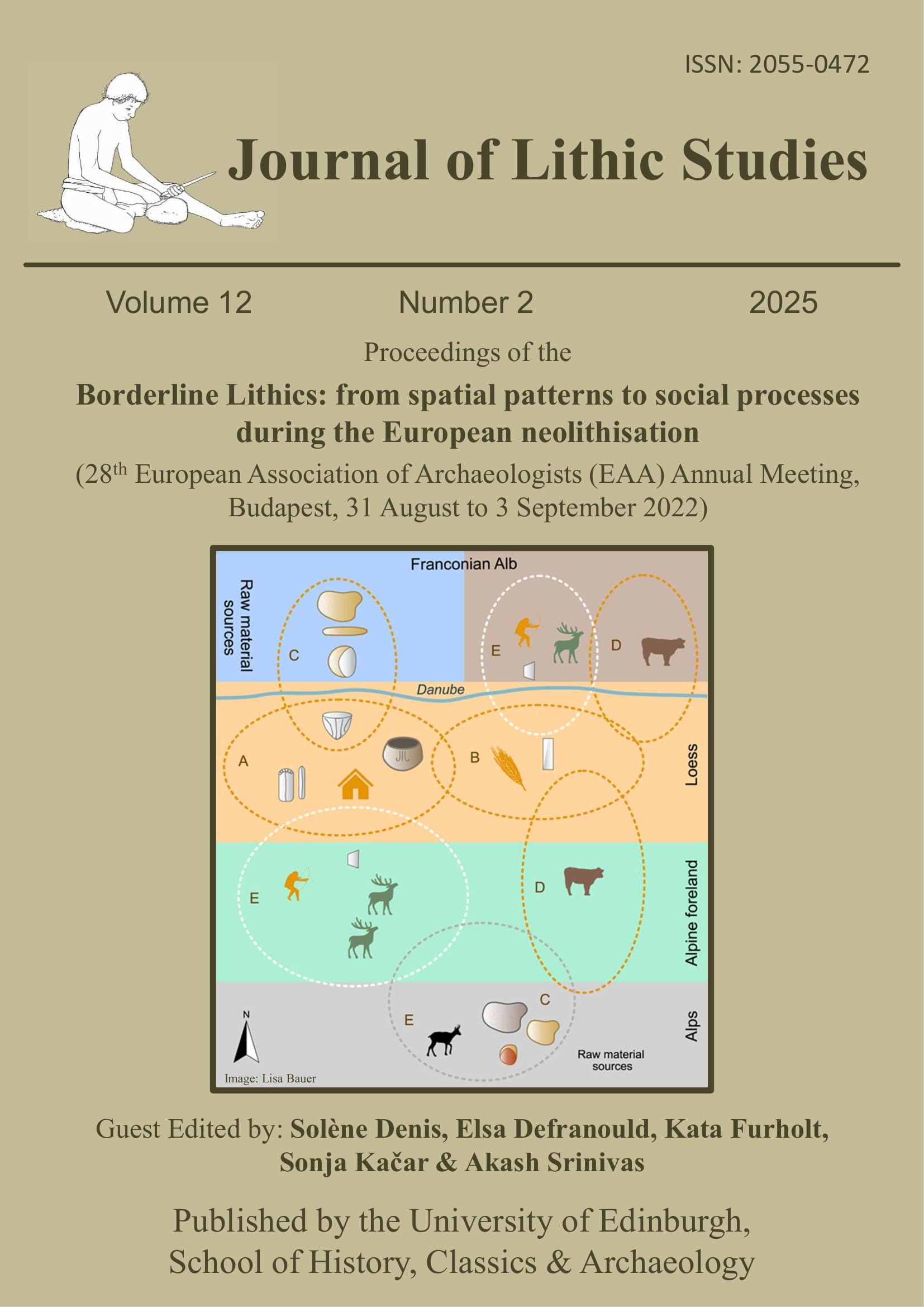
This paper aims to contribute to the discussion on borders and boundaries from the perspective of lithics. European archaeological and historical research has seen numerous endeavours to create an overarching definition of borders of spatial, social, political, linguistic and religious kinds. This is particularly important in the context of the modern, strongly divided European nation states, and this situation has a strong impact on the archaeological concept of culture. Lithic materials are usually not associated with the concepts of culture and group, which was and often still is the coordinate system for prehistoric communities since the Neolithic. How can we look at prehistoric societies as social units and integrate lithic studies into the overarching archaeological narrative? As a first step, we should put these artificial borders aside and take into account as many variables that can interfere with human behaviour as possible. This paper tries to create a framework (referring to some case studies) at micro-, meso-, and macro-scales for structuring spatial, temporal, social, contextual and habitual variables based solely on lithic materials to demonstrate the importance of stone assemblages and litho-scapes in archaeological narratives. By looking at activities involving lithics, we become aware that borders are very diverse and variable, thus cannot be treated as part of a static system. On the contrary, different boundaries (instead of borders) need to be treated as continuously changing units that function in different ways at different scales. Thus, we should try to use a dynamic multiscalar approach in lithic research.
References
Allard, P. 2017, Variabilité des débitages laminaires au Second Mésolithique et au Néolithique ancien dans le nord de la France (VIIe et VIe millénaire BCE). Journal of Lithic Studies, 4(2): 75-103. (in French) ("Variability of blade debitage during the Second Mesolithic and Early Neolithic in northern France (7th and 6th millennium BCE)"). DOI: https://doi.org/10.2218/jls.v4i2.2538
Allard, P. & Denis, S. 2021, Lithic industry, territory and mobility in Western Linear Pottery Culture. Journal of Lithic Studies, 8(1): 1-24. DOI: https://doi.org/10.2218/jls.4444
Allard, P. & Denis, S. 2022, Technical traditions and individual variability in the Early Neolithic: Linear pottery culture flint knappers in the Aisne Valley (France). PLOS ONE, 17(6): e0268442. DOI: https://doi.org/10.1371/journal.pone.0268442
Allard, P., Klaric, L. & Hromadová, B. 2017, Obsidian blade debitage at Kašov-Čepegov I (Bükk culture), Slovakia. Bulgarian e-Journal of Archaeology, 7: 17-35.
URL: https://be-ja.org/index.php/journal/article/view/be-ja-7-1-2017-17-35
Alves, F., Cruz, S., Ribeiro, A., Bastos Silva, A., Martins, J. & Cunha, I. 2020, Walkability Index for Elderly Health: A Proposal. Sustainability, 12(18): 7360.
DOI: https://doi.org/10.3390/su12187360
Andrefsky, W. Jr. (Ed.) 2008, Lithic technology: measures of production, use, and curation. Cambridge University Press, Cambridge, 360 p.
Andrefsky, W. Jr. 2009, The Analysis of Stone Tool Procurement, Production, and Maintenance. Journal of Archaeological Research, 17: 65-103.
DOI: https://doi.org/10.1007/s10814-008-9026-2
Anschuetz, K.F., Wilshusen, R.H. & Scheick, C.L. 2001, An Archaeology of Landscapes: Perspectives and Directions. Journal of Archaeological Research, 9: 157-211.
DOI: https://doi.org/10.1023/A:1016621326415
Antonović, D. 1997, Use of Light White Stone in the Central Balkans Neolithic. Starinar, 48: 33-39.
Antonović, D. 2003, Neolitska industrija glačanog kamena u Srbiji. Archaeological Institute, Monographies 37, Belgrade, 164 p. (in Serbian) ("Neolithic polished stone industry in Serbia")
Antonović, D. 2006, On importance of study of the Neolithic ground stone industry in the terriory of Southeast Europe. Analele Banatului, Arheologie - Istorie, 14(1): 53-62.
Antonović, D., Resimić-Šarić, K. & Cvetković, V. 2005, Stone raw materials in the Vinča culture: Petrographic analysis of assemblage from Vinča and Belovode. Starinar, 55: 53-66.
Apel, J. 2008, Knowledge, Know-how and Raw Material - The Production of Late Neolithic Flint Daggers in Scandinavia. Journal of Archaeological Method and Theory, 15: 91-111. DOI: https://doi.org/10.1007/s10816-007-9044-2
Apel, J. & Knutsson, K. 2006, Skilled Production and Social Reproduction: Aspects of Traditional Stone-Tool Technologies. Proceedings of a Symposium in Uppsala, August 20-24, 2003, Societas Archaeologica Upsaliensis, Uppsala, 454 p.
Appolloni, L., Corazza, M.V. & D’Alessandro, D. 2019, The Pleasure of Walking: An Innovative Methodology to Assess Appropriate Walkable Performance in Urban Areas to Support Transport Planning. Sustainability, 11(12): 3467.
DOI: https://doi.org/10.3390/su11123467
Ashmore, W. 2004, Social Archaeologies of Landscape. In: Companion to Social Archaeology (L. Meskell & R.W. Preucel, Eds.), Blackwell Publishing, Oxford: p. 255-271.
Aspöck, E. 2013, Über die Variabilität von Totenpraktiken. Oder: Probleme einer dichotomen Auffassung von Toten- bzw. Bestattungsbrauchtum. In: “Irreguläre” Bestattungen in der Urgeschichte: Norm, Ritual, Strafe...?: Akten der Internationalen Tagung in Frankfurt a.M. vom 3. bis 5. Februar 2012 (N. Müller-Scheeßel, Ed.), Kolloquien zu Vor- und Frühgeschichte., Rudolf Habelt GmbH, Bonn: p. 25-38. (in German) (“On the variability of mortuary practices. Or: Problems of a dichotomous conception of death and burial customs”)
Assmann, J. 2008, Communicative and Cultural Memory. In: Media and Cultural Memory (A. Erll & A. Nünning, Eds.), Walter de Gruyter, Berlin, New York: p. 109-118.
Audouze, F. & Karlin, C. 2017, La chaîne opératoire a 70 ans : qu’en ont fait les préhistoriens français. Journal of Lithic Studies, 4(2): 5-73. (in French) ("The chaîne opératoire is 70 years old: what have French prehistorians done with it?")
DOI: https://doi.org/10.2218/jls.v4i2.2539
Balkan-Atlı, N., Binder, D. & Cauvin, M.-C. 1999, Obsidian: Sources, workshops and trade in Central Anatolia. In: Neolithic in Turkey. The cradle of civilization. New discoveries (M. Ozdoğan & N. Başgelen, Eds.), Arkeoloji ve Sanat Yayınları, Istanbul: p. 133-145.
Bánesz, L. 1991, Neolitická dielňa na výrobu obsidiánovej industrie v Kašove. Východoslovenský Pravek, 3: 39-68. (in Slovak) (“Neolithic obsidian industry workshop in Kašov”)
Bánesz, L. 1993, Neolitische Werkstatt zur Herstellung von Obsidianindustrie in Kašov. In: Actes du XIIe Congrès international des sciences préhistoriques et protohistoriques : Bratislava, 1-7 septembre 1991 (J. Pavúk, M. Fabis, I. Kuzma, K. Marková, L. Bánesz, P. Bednár, D. Bialeková, G. Fusek & D. Stassíková-Stukovská, Eds.), Institut d’archéologie de l’Académie slovaque des sciences, Union internationale des sciences préhistoriques et protohistoriques, Bratislava, Nitra: p. 432-437. (in German) (“Neolithic workshop for the production of obsidian industry in Kašov”)
Bánffy, E. 2019, First Farmers of the Carpathian Basin: Changing Patterns in Subsistence, Ritual and Monumental Figurines. Oxbow Books, Philadelphia, 172 p.
Biehl, P.F., Gramsch, A. & Marciniak, A. 2002, Archaeologies of Europe: Histories and identities. An introduction. In: Archäologien Europas: Geschichte, Methoden und Theorien (P. F. Biehl, A. Gramsch & A. Marciniak, Eds.), Tübinger archäologische Taschenbücher 3, Waxmann, Münster: p. 25-31.
Binder, D. 2002, Stones making sense: what obsidian could tell about the origin of the Central Anatolian Neolithic. In: The Neolithic of Central Anatolia. Internal Developments and External Relations during the 9th - 6th Millennia cal BC. Proceedings of the CANeW Table Ronde, Istanbul 23-24 November 2001 (F. Gérard & L.C. Thissen, Eds.), Ege Publishing Co, Istanbul: p. 79-90.
Biró T.K. 1989a, A Kup-egyesi neolit lelőhely kőeszközei. Veszprémi Történelmi Tár, 2: 34-41. (in Hungarian) (“Stone tools from the Kup-Egyes Neolithic site”)
Biró T.K. 1989b, A lengyeli kultúra dél-dunántúli kőeszköz-leletanyagainak nyersanyagáról I. Communicationes Archaeologicae Hungariae, 41: 22-31. (in Hungarian) (“The raw material of the stone tool finds of the Lengyel culture in South Transdanubia I”)
Biró T.K. 1990, A lengyeli kultúra dél-dunántúli kőeszköz-leletanyagainak nyersanyagáról II. Communicationes Archaeologicae Hungariae, 42: 66-76. (in Hungarian) (“On the raw material of stone tool finds of the Lengyel culture in South Transdanubia II”)
Biró T.K. 1995, H8 Szentgál-Tűzköveshegy, Veszprém county. Archaeologia Polona, 33: 402-408.
Biró T.K. 1998, Lithic implements and the circulation of the raw materials in the Great Hungarian Plain during the Late Neolithic Period. Magyar Nemzeti Múzeum, Budapest, 350 p.
Biró T.K. 2003, Tevel flint: a special constituent of the Central European LBC lithic inventories. In: Production and Management of Lithic Materials in the European Linienbandkeramik (L. Burnez-Lanotte, Ed.), British Archaeological Reports International Series, Hadrian Books, Oxford: p. 11-17.
Biró T.K. 2014, Carpathian Obsidians: State of Art. In: Lithic raw material exploitation and circulation in Préhistory. A comparative perspective in diverse palaeoenvironments (M. Yamada & A. Ono, Eds.), Etudes et recherches archéologiques de l’Université de Liège. Université de Liège, Service de préhistoire & Centre de recherches archéologiques, Liège: p. 47-68.
Biró T.K. 2018, More on the state of art of Hungarian obsidians. Archeometriai Műhely, 15(3): 213-224.
Biró T.K. & Regenye, J. 2003, Exploitation regions and workshop complexes in the Bakony mountains, Hungary. In: Man and Mining - Mensch und Bergbau. Studies in honour of Gerd Weisgerber on occasion of his 65th birthday (T. Stöllner, G. Körlin, G. Steffens & J. Cierny, Eds.) Der Anschnitt, Beiheft Nr. 16, Deutsches Bergbau-Museum, Bochum: p. 55-63.
Biró T.K. & Regenye, J. 2007, Exploitation and Workshop sites in the Bakony Mts. study of the lithic material. In: Polgár and related cultures in the Middle/Late Neolithic in Central Europe (J. K. Kozłowski & P. Raczky, Eds.), The Polish Academy of Arts and Sciences Kraków & Eötvös Loránd University Institute of Archaeological Sciences Budapest, Kraków & Budapest: p. 261-268.
Biró T.K., Kasztovszky, Zs. & Mester, A. 2021, New-old obsidian nucleus depot find from Besenyőd, NE Hungary. In: Beyond the Glass Mountains. Papers presented for the 2019 International Obsidian Conference 27-29 May 2019, Sárospatak (T.K. Biró & A. Markó, Eds.), Inventaria Praehistorica Hungariae, Magyar Nemzeti Múzeum, Budapest: p. 95-108.
Bleed, P. 2008, Skill Matters. Journal of Archaeological Method and Theory, 15: 154-166. DOI: https://doi.org/10.1007/s10816-007-9046-0
Bokelmann, K. 1986, Rast unter Bäumen. Ein ephemerer mesolithischer Lagerplatz aus dem Duvenseer Moor. Offa. Berichte und Mitteilungen zur Urgeschichte, Frühgeschichte und Mittelalterarchäologie, 43: 149-163. (in German) (“Resting under trees: an ephemeral Mesolithic campsite from the Duvenseer Moor”)
Boroneanţ, A., Virag, C., Astaloș, C. & Bonsall, C. 2018, Sourcing Obsidian from Prehistoric sites in Northwest Romania. Materiale Şi Cercetări Archeologice, 14: 13-23.
Bourdieu, P. 1977, Outline of a Theory of Practice. 1st edition, Cambridge University Press, Cambridge, 260 p.
Bourdieu, P. 1990, The Logic of Practice. Polity Press, Cambridge, 333 p.
Bourdieu, P. 1993, The Field of Cultural Production: Essays on art and literature. Columbia University Press, New York, 322 p.
Bourgeois, Q. & Kroon, E. 2017, The impact of male burials on the construction of Corded Ware identity: Reconstructing networks of information in the 3rd millennium BC. PLOS ONE, 12(10): e0185971. DOI: https://doi.org/10.1371/journal.pone.0185971
Brandt, G., Haak, W., Adler, C.J., Roth, C., Szécsényi-Nagy, A., Karimnia, S., Möller-Rieker, S., Meller, H., Ganslmeier, R., Friederich, S., Dresely, V., Nicklisch, N., Pickrell, J.K., Sirocko, F., Reich, D., Cooper, A. & Alt, K.W. 2013, Ancient DNA Reveals Key Stages in the Formation of Central European Mitochondrial Genetic Diversity. Science, 342(6155): 257-261. DOI: https://doi.org/10.1126/science.1241844
Budziszewski, J. 1999, Flint working of the South-Eastern group of the Funnel Beaker culture: exemplary reception of Chalcolithic socio-economic patterns of the Pontic zone. Baltic-Pontic Studies, 9: 256-281.
Burgert, P., Přichystal, A., Prokeš, L., Petřík, J. & Hušková, S. 2017, The origin and distribution of obsidian in prehistoric Bohemia. Bulgarian e-Journal of Archaeology, 7: 1-15. URL: https://be-ja.org/index.php/journal/article/view/be-ja-7-1-2017-1-15
Cann, J.R. & Renfrew, C. 1964, Characterization of obsidian and its application to the Mediterranean region. Proceedings of the Prehistoric Society, 30: 111-132.
Champion, T. 2017, Centre and Periphery: Comparative Studies in Archaeology. 1st edition, Taylor & Francis Ltd., 264 p.
Chataigner, C. & Barge, O. 2010, GIS (Geographic Information System) for obsidian procurement analysis: pathway modelisation in space and time. In: Von Majkop bis Trialeti: Gewinnung und Verbreitung von Metallen und Obsidian in Kaukasien im 4.-2.Jt.v.Chr., Beiträge des Internationalen Syposiums in Berlin vom 1.-3. Juni 2006 (S. Hansen, A. Hauptmann, I. Motzenbäcker & E. Pernicka, Eds.), Dr Rudof Habelt GmbH, Bonn, p. 1-14. URL: https://missioncaucase.hypotheses.org/files/2016/03/Chataigner-Barge2010_Maikop.pdf
Cheben, M., Hrselová, P., Wunderlich, M. & Szilágyi, K. 2020, Stone tools from the LBK and Želiezovce settlement site of Vráble. In: Archaeology in the Žitava valley I. The LBK and Želiezovce settlement site of Vráble (M. Furholt, I. Cheben, J. Müller, A. Bistáková, M. Wunderlich & Müller-Scheeßel, Nils, Eds.), Scales of Transformation, Sidestone Press, Leiden: p. 363-416.
Clark, G.A. & Barton, C.M. 2017, Lithics, landscapes & la Longue-durée - Curation & expediency as expressions of forager mobility. Prehistoric hunter-gatherers and farmers in the Adriatic and neighboring regions, 450: 137-149.
DOI: https://doi.org/10.1016/j.quaint.2016.08.002
Clarke, D.L. 1968, Analytical Archaeology. Routledge Library Editions, London, 550 p.
Conneller, C., Little, A., Birchenall, J., Milner, N. & Taylor, B. 2018, Making Space through Stone. In: Star Carr, Volume 1: A Persistent Place in a Changing World (N. Milner, C. Conneller & B. Taylor, Eds.), White Rose University Press, York: p. 157-222.
Delage, C. 2017, Once upon a time…the (hi)story of the concept of the chaîne opératoire in French prehistory. World Archaeology, 49(2): 158-173.
DOI: https://doi.org/10.1080/00438243.2017.1300104
Denis, S., Gomart, L., Burnez-Lanotte, L. & Allard, P. 2024, Transmission of lithic and ceramic technical know-how in the Early Neolithic of central-western Europe: Shedding Light on the Social Mechanisms underlying Cultural Transition. Journal of Neolithic Archaeology, 26: 31-63
Diener, A.C. & Hagen, J. 2010, Introduction. Borders, Identity, and Geopolitics. In: Borderlines and Borderlands: Political Oddities at the Edge of the Nation-state (A.C. Diener & J. Hagen, Eds.), Rowman & Littlefield, Lanham: p. 1-12.
Dimić, V. 2015, Traseological markers on ground stone cutting - implements from Lađarište site near Vrnjačka Banja. Journal of Serbian Archaeological Society (Гласник Српског археолошког друштва), 31: 39-74.
Dixon, J.E., Cann, J.R. & Renfrew, C. 1968, Obsidian and the origins of trade. Scientific American, 218: 38-46.
Dobres, M.-A. 2006, Skilled Production and Social Reproduction in prehistory and contemporary archaeology: a personal exegesis on dominant themes and their influences. In: Skilled Production and Social Reproduction: Aspects of Traditional Stone-Tool Technologies - Proceedings of a Symposium in Uppsala, August 20-24, 2003 (J. Apel & K. Knutsson, Eds.), Societas Archaeologica Upsaliensis, Uppsala: p. 25-36.
Dobres, M.-A. & Hoffman, C.R. 1999, The Social Dynamics of Technology: Practice, Politics, and World Views. Smithsonian Institution Press, Washington, 240 p.
Douglass, M.J., Lin, S.C., Braun, D.R. & Plummer, T.W. 2018, Core Use-Life Distributions in Lithic Assemblages as a Means for Reconstructing Behavioral Patterns. Journal of Archaeological Method and Theory, 25(1): 254-288.
DOI: https://doi.org/10.1007/s10816-017-9334-2
Dzbyński, A. 2008, Rytuał i porozumienie. Racjonalne podstawy komunikacji i wymiany w pradziejach Europy Środkowej. Ritual and Understanding: Rational Bases of Communication and Exchange in Prehistoric Central Europe. Instytut Archeologii Uniwersytetu Rzwszowskiego, Rzeszow, 276 p.
Dzbyński, A. 2011, Mr. Blademan. Macrolithic technology - Eneolithic vocabulary and metaphors. Praehistorische Zeitschrift, 38: 173-183.
Edmonds, M. 1995, Stone tools and society. Working stone in Neolithic and Bronze Age Britain. Routledge, London, 212 p.
Eerkens, J.W. & Lipo, C.P. 2007, Cultural Transmission Theory and the Archaeological Record: Providing Context to Understanding Variation and Temporal Changes in Material Culture. Journal of Archaeological Research, 15(3): 239-274.
DOI: https://doi.org/10.1007/s10814-007-9013-z
Eggert, M.K.H., Müller-Scheessel, N. & Samida, S. 2012, Prähistorische Archäologie: Konzepte und Methoden. 4, überarb. Aufl., Attempto Verlag, Tübingen, 482 p. (in German) (“Prehistoric archaeology: concepts and methods”)
Eisenmann, S., Bánffy, E., Dommelen, P. van, Hofmann, K.P., Maran, J., Lazaridis, I., Mittnik, A., McCormick, M., Krause, J., Reich, D. & Stockhammer, P.W. 2018, Reconciling material cultures in archaeology with genetic data: The nomenclature of clusters emerging from archaeogenomic analysis. Scientific Reports, 8(1): 13003.
DOI: https://doi.org/10.1038/s41598-018-31123-z
Faragó, N., Mester, Z. & Király, A. 2019, The knapped stone assemblage from Boldogkőváralja in the light of a new statistical evaluation. Litikum, 7-8: 55.
DOI: https://doi.org/10.23898/litikuma0025
Friedmann, J. 1966, Regional Development Policy: A Case Study of Venezuela. M.I.T. Press, Cambridge, 312 p.
Frieman, C.J. & Hofmann, D. 2019, Present Pasts in the Archaeology of Genetics, Identity, and Migration in Europe: A Critical Essay. World Archaeology, 51(4): 528-545.
DOI: https://doi.org/10.1080/00438243.2019.1627907
Furholt, K. 2024, Depositional Patterning of Obsidian Artifacts: Studying Diverse Value Concepts in the Neolithic Carpathian Basin. In: Reflections on Volcanic Glass: Proceedings of the 2021 International Obsidian Conference (L.R.M. Johnson, K.P. Freund & N. Tripcevich, Eds.). eScholarship, Archaeological Research Facility, Berkeley: p. 9-41.
Furholt, K. 2025, Leaving no stone unturned. The production and use of chipped stone artefacts among the Late Neolithic Lengyel communities of southern Transdanubia during the fifth millennium BC. Römisch-Germanische Kommission, Frankfurt am Main, 385 p.
Furholt, M. 2018a, Massive Migrations? The Impact of Recent aDNA Studies on our View of Third Millennium Europe. European Journal of Archaeology, 21(2): 1-33.
DOI: https://doi.org/10.1017/eaa.2017.43
Furholt, M. 2018b, Translocal Communities - Exploring Mobility and Migration in Sedentary Societies of the European Neolithic and Early Bronze Age. Praehistorische Zeitschrift, 92(2): 304-321. DOI: https://doi.org/10.1515/pz-2017-0024
Furholt, M. 2020, Social Worlds and Communities of Practice: a polythetic culture model for 3rd millennium BC Europe in the light of current migration debates. Préhistoires Méditerranéennes, 8: 2383. DOI: https://doi.org/10.4000/pm.2383
Furholt, M. 2021, Mobility and Social Change: Understanding the European Neolithic Period after the Archaeogenetic Revolution. Journal of Archaeological Research, 29: 481-535. DOI: https://doi.org/10.1007/s10814-020-09153-x
Furholt, M., Hinz, M., Mischka, D., Olausson, D. & Noble, G. (Eds.) 2014, Landscapes, Histories and Societies in the Northern European Neolithic. Verlag Dr. Rudolf Habelt, Bonn, 317 p.
Garrow, D. 2012, Odd deposits and average practice. A critical history of the concept of structured deposition. Archaeological Dialogues, 19: 85-115.
Gibbs, J.P. 1963, The Evolution of Population Concentration. Economic Geography, 39(2): 119. DOI: https://doi.org/10.2307/142505
van Gijn, A.L. 2010, Flint in Focus: Lithic Biographies in the Neolithic and Bronze Age. Sidestone Press, Leiden, 311 p.
Gosden, C. & Marshall, Y. 1999, The Cultural Biography of Objects. World Archaeology, 31(2): 169-178.
Graeber, D. 2001, Toward an Anthropological Theory of Value. The False Coin of Our Own Dreams. Palgrave Macmillan, Palgrave, 352 p.
Groß, D., Lübke, H., Schmölcke, U. & Zanon, M. 2019, Early Mesolithic activities at ancient Lake Duvensee, northern Germany. The Holocene, 29(2): 197-208.
DOI: https://doi.org/10.1177/0959683618810390
Güngördü, F.V. 2010, Obsidian, Trade and Society in the Central Anatolian Neolithic. Master’s thesis at the Department of Archaeology and History of Art, Graduate School of Economics and Social Sciences, Bilkent University, Ankara, 122p.
Gurova, M. 2014, “Cereal Polish”: Diagnosis, Challenge or Confusion. In: International Conference on Use-Wear Analysis: Use-Wear 2012 (J. Marreiros, N. Bicho & J. F. Gibaja, Eds.), Cambridge Scholars Publishing, Cambridge: p. 90-102.
Hallam, E. & Hockey, J. 2018, Remembering as Cultural Process. In: Death, Mourning, and Burial: A Cross-Cultural Reader (A.C.G.M. Robben, Ed.), John Wiley & Son, Inc., New York: p. 52-63.
Hamilakis, Y. & Labanyi, J. 2008, Introduction: Time, Materiality, and the Work of Memory. History and Memory, 20(2): 5-17. DOI: https://doi.org/10.2979/his.2008.20.2.5
Hillebrand, J. 1928, A nyírlugosi obsidiannucleus depotleletről, Archaeologiai Értesítő, 42: 39-42. (in Hungarian) (“On the Nyírlugos obsidian core depot find”)
Hofmann, D. 2015, What Have Genetics Ever Done for Us? The Implications of aDNA Data for Interpreting Identity in Early Neolithic Central Europe. European Journal of Archaeology, 18(3): 454-476. DOI: https://doi.org/10.1179/1461957114Y.0000000083
Hofmann, D. 2020, Structured deposition in the Linearbandkeramik - is there something to talk about? In: Magical, Mundane or Marginal? Deposition practices in the Early Neolithic Linearbandkeramik culture (D. Hofmann, Ed.), Sidestone Press, Leiden: p. 9-32.
Högberg, A. 2006, Continuity of place: actions and narratives. In: Skilled Production and Social Reproduction: Aspects of Traditional Stone-Tool Technologies - Proceedings of a Symposium in Uppsala, August 20-24, 2003 (J. Apel & K. Knutsson, Eds.), Societas Archaeologica Upsaliensis, Uppsala: p. 187-206.
Inizan, M., Reduron-Ballinger, M., Roche, H. & Tixier, J. 1999, Technology and Terminology of Knapped Stone. Cercle de Recherches et d’Etudes Préhistoriques, Nanterre, 189 p.
Ion, A. 2017, How Interdisciplinary is Interdisciplinarity? Revisiting the impact of aDNA research for the archaeology of human remains. Current Swedish Archaeology, 25: 177-198. DOI: https://doi.org/10.17863/CAM.18601
Jones, A. 2007, Memory and Material Culture. Cambridge University Press, Cambridge, 274 p.
Jones, S. 1997, The Archaeology of Ethnicity. Constructing identities in the past and present. Routledge, London/New York, 196 p.
Joyce, R.A., Gillespie, S.D., Project Muse & Project Muse (Eds.) 2015, Things in Motion: Object Itineraries in Anthropological Practice. School for Advanced Research Press, Santa Fe, 290 p.
Judik, K. & Biró T.K. 2001, Petroarchaeological research on the Lengyel culture polished stone axes from Aszód, Papi Földek. In: Sites and stones: Lengyel culture in Western Hungary and beyond: A review of the current research (J. Regenye, Ed.), Visa Press, Veszprém: p. 119-129.
Kaczanowska, M., Kozłowski, J.K. & Sümegi, P. 2009, Lithic industries from the Öcsöd-Kováshalom tell-like settlement in Hungary. In: Ten years after: The Neolithic of the Balkans, as uncovered by the last decade of research. Proceedings of the Conference held at the Museum of Banat on November 9th-10th, 2007 (F. Draşovean, D.L. Ciobotaru & M. Maddison, Eds.), Bibliotheca historica et archaeologica banatica., Editura Marineasa, Timişoara: p. 125-149.
Kadrow, S. 2017, The concept of the Copper Age/Eneolithic. In: The Past Societies, Polish Lands from the First Evidence of Human Presence to the Early Middle Ages, Volume 2 (P. Urbańczyk & P. Włódarczak, Eds.), Institute of Archaeology and Ethnology of the Polish Academy of Sciences, Warszawa: p. 65-106.
Kasztovszky, Zs., Biró T., K. & Kis, Z. 2014, Prompt Gamma Activation Analysis of the Nyírlugos obsidian core depot find. Journal of Lithic Studies, 1(1): 151-163.
DOI: https://doi.org/10.2218/jls.v1i1.784
Király, A., Faragó, N. & Mester, Zs. 2020, Hasznos rítusok és haszontalan technikák - Useful Rites and Unfit Techniques, Dissertationes Archaeologicae, Supplementum 3: 9-42. (in Hungarian) (“Useful rituals and useless techniques. Some theoretical issues of the archaeological identification of ritual action in a knapped stone artefact”)
DOI: https://doi.org/10.17204/dissarch.suppl3.9
Klassen, L. 2004, Jade und Kupfer. Untersuchungen zum Neolithisierungsprozess im westlichen Ostseeraum unter besonderer Berücksichtigung der Kulturentwicklung Europas 5500-3500 BC. Aarhus University Press, Aarhus, 436 p. (in German) (“Jade and Copper. Studies on the Neolithisation process in the western Baltic Sea region with special consideration of the cultural development of Europe 5500-3500 BC”)
Kopytoff, I. 1986, The cultural biography of things: commoditization as process. In: The social life of things: commodities in cultural perspective (A. Appadurai, Ed.), Cambridge University Press, Cambridge: p. 64-94.
Kufel-Diakowska, B. & Wilk, S. 2018, Microlithis from Graves of the Lublin-Volhynian at Site 2 in Ksiąznice, Swietokrzyskie Voivodeship. Sprawozdania Archeologiczne, 70: 243-268.
Le Brun-Ricalens, F. & Potin, Y. 2018, In Memoriam Jacques Tixier (1925-2018). Litikum, 6: 5-12. DOI: https://doi.org/10.23898/litikuma0021
Lech, J. 1990, The organization of siliceous rock supplies to the Danubian early farming communities (LBK), Central European examples. In: Rubané et Cardial, Actes du Colloque de Liège, 1988 (D. Cahen & M. Otte, Eds.), Études et Recherches Archéologiques de l’Université de Liège, Université de Liège, Liège: p. 51–59
Lewis, M. & Arntz, M. 2020, Introduction. The Chaîne Opératoire: Past, Present and Future. Archaeological Review from Cambridge, 35(1): 6-16.
Libera, J. & Zakościelna, A. 2011, Cyrkulacja krzemienia wołyńskiego w okresie neolitu i we wczesnej epoce brązu na ziemiach polskich. In: Miedzy Baltykiem a Morzem Czarnym: Szlaki miedzymorza IV - I tys. przed Chr. (M. Ignaczak, A. Kośko & M. Szmyt, Eds.), Wydawnictwo Poznańskie, Poznań: p. 83-115. (in Polish) (“Circulation of Volhynian flint in the Neolithic period and the early Bronze Age in Polish lands”)
Lichter, C. 2001, Untersuchungen zu den Bestattungssitten des südosteuropäischen Neolithikums und Chalkolithikums. P. von Zabern, Mainz am Rhein, 474 p. (in German) (“Investigations into the burial customs of the south-east European Neolithic and Chalcolithic periods”)
Manninen, M.A. & Knutsson, K. 2014, Lithic raw material diversification as an adaptive strategy - Technology, mobility, and site structure in Late Mesolithic northernmost Europe. Journal of Anthropological Archaeology, 33: 84-98.
DOI: https://doi.org/10.1016/j.jaa.2013.12.001
Manolakakis, L. 2005, Les industries lithiques énéolithiques de Bulgarie. Leidorf, Rahden, Westfalen, 314 p. (in French) (“Aeneolithic lithic industries in Bulgaria”)
Manolakakis, L. 2017, So long blades...: Materiality and symbolism in the north-eastern Balkan Copper Age. In: European Archaeology - Identities & Migrations: Hommages à Jean-Paul Demoule (L. Manolakakis, N. Schlanger & A. Coudart, Eds.), Sidestone Press, Leiden: p. 265-284.
Marić, M. 2015, Modelling obsidian trade routes during Late Neolithic in the South-East Banat Region of Vršac using GIS. Starinar, 65: 37-52.
Masclans, A., Hamon, C., Jeunesse, C. & Bickle, P. 2021, A sexual division of labour at the start of agriculture? A multi-proxy comparison through grave good stone tool technological and use-wear analysis. PLoS ONE, 16(4): e0249130.
DOI: https://doi.org/10.1371/journal.pone.0249130
Masclans, A., Tvrdý, Z., Pavúk, J., Cheben, M. & Bickle, P. 2021, Exploring sexual division of labour at “Nitra Horné Krškany” cemetery using stone tool use-wear analysis, physical activity markers, diet, and mobility as proxies. Archaeological and Anthropological Sciences, 13(7): 109.
DOI: https://doi.org/10.1007/s12520-021-01318-z
Massa, M. 2021, A multiscalar and multivariate approach to the analysis of social and cultural boundaries in Early Bronze Age Western Anatolia. In: Borders in Archaeology: Anatolia and the South Caucasus ca. 3500-500 BCE (L. d’Alfonso & K.S. Rubinson, Eds.), Ancient Near Eastern Studies Supplement Series, Peeters Publishers, Leuven: p. 93-122. DOI: https://doi.org/10.2307/j.ctv28bqkqk.8
Meier-Arendt, W. & Bóna, I. (Eds.) 1992, Bronzezeit in Ungarn: Forschungen in Tell-Siedlungen an Donau und Theiss. Ausstellungskatalog. Stadt Frankfurt Dez. Kultur u. Wissenschaft, Frankfurt a. Main, 216 p. (in German) (“Bronze Age in Hungary: Research in Tell settlements on the Danube and Tisza. Exhibition catalogue”)
Mester, Z. & Tixier, J. 2013, Pot à lames: The Neolithic Blade Depot from Boldogkőváralja (Northeast Hungary). In: Moments in Time. Papers Presented to Pál Raczky on His 60th Birthday (A. Anders, G. Kalla, V. Kiss, G. Kulcsár & G.V. Szabó, Eds.), Ősrégészeti Tanulmányok, L’Harmattan, Budapest: p. 173-186.
Migal, W. 2006, The macrolithic flint blades of the neolithic times in Poland. In: Skilled Production and Social Reproduction: Aspects of Traditional Stone-Tool Technologies - Proceedings of a Symposium in Uppsala, August 20-24, 2003 (J. Apel & K. Knutsson, Eds.), Societas Archaeologica Upsaliensis, Uppsala: p. 387-398.
Milić, M. 2016, Obsidian exchange and societies in the Balkans and the Aegean from the late 7th to 5th millennia BC. PhD Thesis at the Department of Anthropology, University College London, London, 385 p.
Miller, J. 1990, Absolutism in Seventeenth-century Europe. Palgrave Macmillan, Basingstoke, 280 p.
Muller, A., Shipton, C. & Clarkson, C. 2023, The Proceduralization of Hominin Knapping Skill: Memorizing Different Lithic Technologies. Cambridge Archaeological Journal, 33(4): 655-672. DOI: https://doi.org/10.1017/S0959774323000070
Müller, J. 2013, Kossinna, Childe and aDNA. Comments on the construction of identities. Current Swedish Archaeology, 21: 35-37.
Müller, J., Käppel, L., Ricci, A. & Weinelt, M. 2022, Social, environmental, and cultural connectivity: A concept for an understanding of society and the environment. In: Connectivity Matters! Social, Environmental and Cultural Connectivity in Past Societies (J. Müller, Ed.), ROOTS Studies 02, Sidestone Press, Leiden, p. 13-24.
Newman, D. 2006, The lines that continue to separate us: borders in our `borderless’ world. Progress in Human Geography, 30(2): 143-161.
DOI: https://doi.org/10.1191/0309132506ph599xx
Odell, G.H. 2000, Stone Tool Research at the End of the Millennium: Procurement and Technology. Journal of Archaeological Research, 8(4): 269-331.
DOI: https://doi.org/10.1023/A:1009439725979
Odell, G.H. 2006, Lithic Analysis. University of Tulsa, Oklahoma, 262 p.
Parker Pearson, M. 2005, The Archaeology of Death and Burial. The History Press, Stroud, 256 p.
Pelegrin, J. 1990, Prehistoric Lithic Technology: Some Aspects of Research. Archaeological Review from Cambridge, 9: 116-125.
Pelegrin, J. 2006, Long blade technology in the Old World: an experimental approach and some archaeological results. In: Skilled Production and Social Reproduction: Aspects of Traditional Stone-Tool Technologies - Proceedings of a Symposium in Uppsala, August 20-24, 2003 (J. Apel & K. Knutsson, Eds.), Societas Archaeologica Upsaliensis, Uppsala: p. 37-68.
Pelegrin, J. 2012, New Experimental Observations for the Characterization of Pressure Blade Production Techniques. In: The Emergence of Pressure Blade Making: From Origin to Modern Experimentation (P.M. Desrosiers, Ed.), Springer, Boston: p. 465-500.
DOI: https://doi.org/10.1007/978-1-4614-2003-3_18
Pétrequin, P., Cassen, S., Errera, M., Klassen, L., Sheridan, A. & Pétrequin, A.-M. (Eds.) 2012, Jade : grandes haches alpines du Néolithique européen : Ve au IVe millénaires av. J.-C. Presses Universitaires de Franche-Comté, Besançon, 1520 p. (in French) (“Jade: large Alpine axes from the European Neolithic: 5th to 4th millennia BC”)
Preuß, J. 1998, Das Neolithikum in Mitteleuropa. Beier and Beran, Weissbach: 700 p. (in German) (“The Neolithic in Central Europe”)
Raczky, P., Faragó, N. & Füzesi, A. 2022, A special find assemblage from the late Neolithic tell of Polgár-Csőszhalom: a contextual re-assessment. In: Walking among ancient trees: Studies in honour of Ryszard Grygiel and Peter Bogucki on the 45th anniversary of their research collaboration (M. Grygiel & P. Obst, Eds.), Wydawnictwo Fundacji Badań Archeologicznych Imienia Profesora Konrada Jażdżewskiego, Kraków: p. 317-348.
Regenye, J. 2001, Lengyel culture settlements around Tűzköveshegy in Szentgál (Veszprém County, Hungary. In: Sites and Stones. Lengyel Culture in Western Hungary and Beyond. A review of the current research. Lengyel’99 and IGCP-442 conference (J. Regenye, Ed.), Veszprém Megyei Múzeumok Igazgatósága, Veszprém: p. 71-79.
Reich, D. 2018, Who We Are and How We Got Here: Ancient DNA and the New Science of the Human Past. Pantheon, New York, 368 p.
Renfrew, C. 1975, Trade as Action at a Distance: Questions of Integration and Communication. In: Ancient Civilization and Trade (J.A. Sabloff & C.C. Lamberg-Karlovsky, Eds.), School of American Research, University of New Mexico Press, Albuquerque: p. 3-60.
Renfrew, C., Cann, J.R. & Dixon, J.E. 1965, Obsidian in the Aegean. The Annual of the British School at Athens, 60: 225–247.
Renfrew, C., Dixon, J.E. & Cann, J.R. 1966, Obsidian and early cultural contact in the Near East. Proceedings of the Prehistoric Society, 32: 30-72.
Ribeiro, A. 2022, Archaeology and Intentionality. Understanding Ethics and Freedom in Past and Present Societies. Routledge, London, 198 p.
Richards, C. & Thomas, J. 1984, Ritual activity and structured deposition in Later Neolithic Wessex. In: Neolithic studies. A review of some current research (R. Bradley & J. Gardiner, Eds.), British Archaeological Reports British Series, Oxford: p. 189-218.
Ricq-de Bouard, M. 1993, Trade in Neolithic Jadeite Axes from the Alps: New Data. In: Trade and Exchange in Prehistoric Europe (C. Scarre & F. Healy, Eds.), Oxbow Books, Oxford: p. 61-67.
Rigaud, S., Manen, C. & García-Martínez de Lagrán, I. 2018, Symbols in motion: Flexible cultural boundaries and the fast spread of the Neolithic in the western Mediterranean. PLoS ONE, 13(5): e0196488. DOI: https://doi.org/10.1371/journal.pone.0196488
Roalkvam, I. 2022, Exploring the composition of lithic assemblages in Mesolithic South-Eastern Norway. Journal of Archaeological Science: Reports, 42: 103371.
DOI: https://doi.org/10.1016/j.jasrep.2022.103371
Roberts, B.W., Vander Linden, M. (2011). Investigating Archaeological Cultures: Material Culture, Variability, and Transmission. In: Investigating Archaeological Cultures (B. Roberts, M. Vander Linden, Eds.), Springer, New York.
DOI: https://doi.org/10.1007/978-1-4419-6970-5_1
Robertson, A., Karamata, S. & Šarić, K. 2009, Overview of ophiolites and related units in the Late Palaeozoic-Early Cenozoic magmatic and tectonic development of Tethys in the northern part of the Balkan region. Lithos, 108(1): 1-36.
DOI: https://doi.org/10.1016/j.lithos.2008.09.007
Rowlands, M. 2009, Centre and periphery: a review of a concept. In: Centre and Periphery in the Ancient World (M. Rowlands, M. Larsen & K. Kristiansen, Eds.), Cambridge University Press, Cambridge, New York, Port Chester, Melbourne, Sydney: p. 1-12.
Rumley, D. & Minghi, J.V. 2014, The Geography of Border Landscapes. Routledge, London, 332 p. DOI: https://doi.org/10.4324/9781315746593
Scharl, S., Denis, S., Koch, I., Schyle, D., Gehlen, B., Collin, J.-P., Allard, P., Delvigne, V. & Grooth, M. de 2021, Studying Neolithic lithics - from a cross-border dialogue to a common language. Journal of Neolithic Archaeology, 23: 115-128.
DOI: https://doi.org/10.12766/jna.2021.5
Shennan, S. 1989, Introduction: Archaeological Approaches to Cultural Identity. In: Archaeological Approaches to Cultural Identity (S. Shennan, Ed.), Unwin Hyman, London: p. 1-32.
Šiška, S. 1995, Zur Problematik des Untergangs der Bükker Kultur. Slovenská Archeológia, 43(1): 5-26. (in German) (“The problem of the decline of Bükk culture”)
Skar, B. & Coulson, S. 1986, Evidence of behaviour from refitting‐a case study. Norwegian Archaeological Review, 19(2): 90-102.
DOI: https://doi.org/10.1080/00293652.1986.9965434
Sørensen, C., Bjørnevad, M. & Bye-Jensen, P. 2020, A biographical study of Neolithic hoarding: A regional case study of Funnel Beaker Culture hoards from the Southern Limfjord area, Denmark. Danish Journal of Archaeology, 9: 1-24.
DOI: https://doi.org/10.7146/dja.v9i0.114837
Sørensen, M. & Sternke, F. 2004, Nørregård VI. - Late Glacial Hunters in Transition. In: Hunters in a changing world. Environment and Archaeology of the Pleistocene-Holocene Transition (T. Terberger & B.V. Eriksen, Eds.), Internationale Archäologie - Arbeitsgemeinschaft, Tagung, Symposium, Kongress, Verlag Marie Leidorf, Radhen/West: p. 85-113.
Sørensen, M., Lübke, H., Groß, D., Milner, N., Conneller, C. & Taylor, B. 2018, The Early Mesolithic in Southern Scandinavia and Northern Germany. In: Star Carr, A Persistent Place in a Changing World, (N. Milner, C. Conneller & B. Taylor, Eds.), White Rose University Press, York: p. 305-330.
Soressi, M. & Geneste, J.-M. 2011, The history and efficacy of the Chaîne Opératoire approach to lithic analysis: Studying techniques to reveal past societies in an evolutionary perspective. PaleoAnthropology, 2011: 334-350.
DOI: https://doi.org/10.4207/PA.2011.ART63
Staniuk, R., Furholt, M., Müller-Scheessel, N. & Cheben, I. 2020, The archaeological features from the LBK and Želiezovce settlement site of Vráble. In: Archaeology in the Žitava valley I. The LBK and Želiezovce settlement site of Vráble (M. Furholt, I. Cheben, J. Müller, A. Bistáková, M. Wunderlich & N. Müller-Scheeßel, Eds.), Scales of Transformation, Sidestone Press, Leiden: p. 95-158.
Starnini, E., Szakmány, Gy., Józsa, S., Kasztovszky, Zs., Szilágyi, V., Maróti, B., Voytek, B., Horváth, F. & Reingruber, A. 2015, Lithics from the tell site Hódmezővasarhely-Gorzsa (Southeast Hungary): Typology, technology, use and raw material strategies during the Late Neolithic (Tisza culture). In: Neolithic and Copper Age between the Carpathians and the Aegean Sea. Chronologies and Technologies from the 6th to the 4th Millennium BCE. International Workshop Budapest 2012 (S. Hansen, P. Raczky & A. Anders, Eds.), Archäologie in Eurasien, Habelt-Verlag, Bonn: p. 105-128.
Stout, D. 2002, Skill and Cognition in Stone Tool Production: An Ethnographic Case Study from Irian Jaya. Current Anthropology, 43(5): 693-722.
DOI: https://doi.org/10.1086/342638
Szakmány, Gy., Kasztovszky, Zs., Szilágyi, V., Starnini, E., Friedel, O. & Biró, K.T. 2011, Discrimination of Prehistoric polished stone tools from Hungary with non-destructive chemical Prompt Gamma Activation Analyses (PGAA). European Journal of Mineralogy, 23(6): 883-893. DOI: https://doi.org/10.1127/0935-1221/2011/0023-2148
Szakmány, Gy., Kovács, Z., Fehér, K. & Anders, A. 2019, Késő neolitikus sírokból előkerült csiszolt kőeszközök archaeometriai vizsgálati eredményei Polgár-Csőszhalom lelőhelyről. In: Saxa loquuntur - Kőbe zárt történetek: 10. Kőzettani és Geokémiai Vándorgyűlés (E. Pál-Molnár, R. H. Lukács, S. Harangi, M. Szemerédi, B. Németh, K. Molnár & M. É. Jankovics, Eds.), MTA-ELTE Vulkanológiai Kutatócsoport, SZTE Ásványtani, Geokémiai és Kőzettani Tanszék „Vulcano” Kőzettani és Geokémiai Kutatócsoport, Budapest: p. 79. (in Hungarian) (“Archaeometric analysis results of polished stone tools recovered from Late Neolithic graves from the Polgár-Csőszhalom site”)
Szakmány, Gy., Sági, T., Józsa, S., Szilágyi, V., Oláh, I., Szilágyi, K. & Osztás, A. 2021, Előzetes eredmények Alsónyék neolitikus csiszolt kőeszközeinek nyersanyagairól. In: 11. Kőkor Kerekasztal Konferencia Programfüzet (Király, A. Ed.), Eötvös Loránd Tudományegyetem Régészettudományi Intézet, Budapest: p. 19-20. (in Hungarian) (“Preliminary results on the raw materials of the Neolithic polished stone tool assemblage at Alsónyék”)
Szakmány, Gy., Starnini, E., Horváth, F. & Bradák, B. 2011, Investigating Trade and Exchange Patterns in Prehistory: Preliminary Results of the Archaeometric Analyses of Stone Artefacts from Tell Gorzsa (South-East Hungary). In: Proceedings of the 37th International Symposium on Archaeometry 12th - 16th May 2008, Siena, Italy (I. Turbanti-Memmi, Ed.), Springer, Berlin & Heidelberg: p. 311-319.
Szeliga, M. 2021, The inflow of obsidian north of the Carpathians during the Neolithic chrono-cultural variability of distribution. In: Beyond the Glass Mountains. Papers presented for the 2019 International Obsidian Conference 27-29 May 2019, Sárospatak (K. Biró T. & A. Markó, Eds.), Inventaria Praehistorica Hungariae., Magyar Nemzeti Múzeum, Budapest: p. 69-94.
Szilágyi, K. 2018a, A Field survey of knappable raw materials in the Eastern Mecsek area. Hungarian Archaeology E-Journal, 1-9.
Szilágyi, K. 2018b, Lithic Raw Material Procurement in the Late Neolithic Southern-Transdanubian Region: A Case Study from the Site of Alsónyék-Bátaszék. Archaeologia Polona, 56: 123-136.
Szilágyi, K. 2019, A késő neolitikus lengyeli kultúra délkelet-dunántúli csoportjának pattintott kőeszközkészítő tevékenysége, PhD Thesis at the Department of Prehistoric Archaeology, Eötvös Loránd University, Budapest. (in Hungarian) (“The chipped stone tool-making activity of the southeastern Transdanubian group of the late Neolithic Lengyel culture”)
Szilágyi, K. 2022, Kőzet(tér)képek: Kárpát-medence neolitikus és rézkori közösségeinek kapcsolatrendszere a kőeszközök alapján. In: 12. Kőkor Kerekasztal Konferencia Programfüzet (Markó, A. Ed.), Magyar Nemzeti Múzeum, Budapest: p. 23. (in Hungarian) (“Lito(scapes): the network system of the Neolithic and Copper Age communities of the Carpathian Basin based on stone tools”)
Szilágyi, K. 2023a, Bringing social process into lithic studies. Implementing the chaîne opératoire concept into the analysis of Neolithic stone material. In: From tea leaves to leaf-shaped tools. Studies in honour of Zsolt Mester on his sixtieth birthday (A. Király, Ed.), Lithic Research Roundtable & Institute of Archaeological Sciences, Eötvös Loránd University, Budapest, p. 303-323. DOI: https://doi.org/10.23898/litikumsi02a15
Szilágyi, K. 2023b, Perversion of the Pareto principle: Using a bottom-up approach to study burial practices in the Late Neolithic Carpathian Basin. In: Rethinking Neolithic Societies. New Perspectives on Social Relations, Political Organization and Cohabitation (C. Heitz, M. Wunderlich, M. Hinz & M. Furholt, Eds.), Open Series in Prehistoric Archaeology (OSPA), Sidestone Press, Leiden: p. 173-198.
Szilágyi, K., Szakmány, Gy., Sági, T., Józsa, S., Szilágyi, V., Oláh, I., Osztás, A. & Biró T., K. 2022, Preliminary results of provenance studies on the polished stone material at the Neolithic site of Alsónyék, Hungary. In: 10th International Scientific Conference Methodology/Archaeometry, Zagreb, 1st-2nd December 2022. Book of Abstracts (M. Ina, Ed.), Faculty of Humanities and Social Sciences of the University of Zagreb, Zagreb: p. 43-44.
Szilágyi, V., Furholt, K., Kovács, Z., Hasrsányi, I., Osztás, A. & Szakmány, Gy. 2025, “Whitestone” - a specific polished stone tool raw material in the Late Neolithic of Southern Hungary. Heritage, 8(3): 112. DOI: https://doi.org/10.3390/heritage8030112
Szilágyi, V., Kovács, Z., Harsányi, I., Osztás, A., Szilágyi, K. & Szakmány, Gy. 2023, Ismeretlen ismerős: A “fehérkő”, egy különleges késő neolit kőeszköz nyersanyag Dél-Magyarországon. In: Lösz2: 13. Kőzettani és Geokémiai Vándorgyűlés. Előadások és poszter kivonatok (A. Varga, Ed.), Szegedi Tudományegyetem Ásványtani, Geokémiai és Kőzettani Tanszék, Szeged: p. 74-75. (in Hungarian) (“Unknown acquaintance: the "white stone", a unique Late Neolithic stone tool raw material in Southern Hungary”)
Szilágyi, V., Szakmány, Gy., Józsa, S., Szilágyi, K., Harsányi, I., Kasztovszky, Zs. & Kovács, Z. 2022, A metadolerit nyersanyagú csiszolt kőeszközök regionális kapcsolatjelző szerepe az őskorban. In: Calce et malleo - Mésszel és kalapáccsal:12. Kőzettani és Geokémiai Vándorgyűlés Miskolc, 2022. Szptember 22-24. (B. Fehér, K. Molnár, R. Lukács, G. Czuppon & E. Kereskényi, Eds.), Csillagászati és Földtudományi Kutatóközpont, Földtani és Geokémiai Intézet, Budapest: p. 130. (in Hungarian) (“The role of metadolerite polished stone tools as regional contact markers in prehistory”)
Trampota, F. & Přichystal, A. 2024, On Foot, by Boat: Distribution methods of raw materials suitable for lithics in Central Europe in c. 4900-3400 BCE. Journal of Lithic Studies, 11(1): 1-23. DOI: https://doi.org/10.2218/jls.7971
Tykot, R.H. 2019, Geological Sources of Obsidian on Lipari and Artifact Production and Distribution in the Neolithic and Bronze Age Central Mediterranean. In: Scientific Studies of Obsidian Sources and Trade (R. H. Tykot, M. C. Martinelli & A. Vianello, Eds.), Open Archaeology, 5: 83-105. DOI: https://doi.org/10.1515/opar-2019-0007
Vander Linden, M. 2011, To Tame a Land: Archaeological Cultures and the Spread of the Neolithic in Western Europe. In: Investigating Archaeological Cultures: Material Culture, Variability, and Transmission (B.W. Roberts & M. Vander Linden, Eds.), Springer, New York: p. 289-319. DOI: https://doi.org/10.1007/978-1-4419-6970-5_15
Vander Linden, M. 2016, Population history in third-millennium-BC Europe: assessing the contribution of genetics. World Archaeology, 48(5): 714-728.
DOI: https://doi.org/10.1080/00438243.2016.1209124
Voytek, B. 1990, The use of stone resources, In: Selevac: A Neolithic Village in Yugoslavia (R. Tringham & D. Krstić, Eds.), Monumenta archaeologica, Institute of Archaeology, University of California, Los Angeles: p. 437-494.
Werra, D.H., Siuda, R. & Małecka-Kukawka, J. 2018, A Danubian Raw Material Exchange Network: A Case Study from Chełmno Land, Poland. In: Between History and Archaeology: Papers in honour of Jacek Lech (D. H. Werra & M. Woźny, Eds.), Archaeopress, Oxford: p. 211-224. DOI: https://doi.org/10.2307/j.ctvndv6qh.23
Wilk, S. 2006, Graves of the Lublin-Volhynian culture at site 2 in Książnice, District of Busko Zdrój 2004 exploration season. Sprawozdania Archeologiczne, 58: 247-270.
Wilk, S. & Kufel-Diakowska, B. 2016, The Lublin-Volhynian culture retouched blade daggers in light of usewear analysis of artefacts from burials at site 2 in Książnice, Poland. Archaeologia Polona, 54: 151-165.
Williams Thorpe, O., Warren, S.E. & Nandris, J.G. 1984, The distribution and provenance of archaeological obsidian in central and eastern Europe. Journal of Archaeological Science, 11(3): 183-212. DOI: https://doi.org/10.1016/0305-4403(84)90001-3
Wilson, P. 2000, Absolutism in Central Europe. Routledge, London, 188 p.
Wolf, E.R. 1984, Culture: Panacea or Problem? American Antiquity, 49(2): 393-400.
DOI: https://doi.org/10.1017/S0002731600070463
Wynn, T. 1993, Layers of thinking in tool behavior. In: Tools, Language and Cognition in Human Evolution (K. R. Gibson & T. Ingold, Eds.), Cambridge University Press, Cambridge: p. 389-406.
Wynn, T. & Coolidge, F.L. 2014, Technical cognition, working memory and creativity. Pragmatics & Cognition, 22(1): 45-63. DOI: https://doi.org/10.1075/pc.22.1.03wyn
Zakościelna, A. 2000, Aus den Untersuchungen der Lublin-Wolynien-Kultur mit bemalter Keramik Feuersteinindustrie. In: A turning of ages. Im Wandel der Zeiten: jubilee book dedicated to professor Jan Machnik on his 70th anniversary (S. Kadrow, Ed.), Institute of Archaeology and Ethnology, Polish Academy of Sciences, Kraków: p. 507-543. (in German) (“From the investigations of the Lublin-Volynia culture with painted pottery. Flint industry”)
Zakościelna, A. 2006, Flint inventories of Grave 5 of the Lublin-Volhynian Culture of Site 2 in Książnice, Busko Zdrój District. Sprawozdania Archaeologiczne, 58: 271-291.
Zakościelna, A. 2018, The mainstream of Eneolithic flint-working of the Balkan-Danubian cultures. In: Multas per Gentes et Multa per Saecula (P. Valde-Nowak, K. Sobczyk, M. Nowak & J. Źrałka, Eds.), Institute of Archaeology, Jagiellonian University, Kraków: p. 475-484.
Zakościelna, A. & Libera, J. 2007, Geometric microlith in grave inventories of Neolithic cultures in Małopolska (south-eastern Poland). In: Contributions to the Central European Stone Age: papers dedicated to the late Professor Zbigniew Bagniewski (M. Masojć, T. Płonka, B. Ginter & S. K. Kozłowski, Eds.), Uniwersytet Wrocławski, Instytut Archeologii, Wrocław: p. 257-270.
Zakościelna, A. & Matraszek, B. 2007, Die Gräber der Lublin-Wolhynien-Kultur aus der Fundstelle „Grodzisko” in Złota, Landkreis Sandomierz. In: The Lengyel, Polgár and related cultures in the Middle/Late Neolithic in Central Europe (J.K. Kozłowski & P. Raczky, Eds.), The Polish Academy of Arts and Sciences Kraków, Eötvös Loránd University, Institute of Archaeological Sciences Budapest, Kraków: p. 411-429. (in German) (“The graves of the Lublin-Wolhynia culture from the ‘Grodzisko’ site in Złota, Sandomierz district”)
Zalai-Gaál, I. 2002a, Der spätneolithische geschliffene Steingerätbestand in Südtransdanubien. I. Die analytische Bearbeitung des Fundmaterials. Wosinszky Mór Múzeum Évkönyve, 24: 7-79. (in German) (“The Late Neolithic ground stone tool assemblage in southern Transdanubia. I. The analytical processing of the find material”)
Zalai-Gaál, I. 2002b, Die Neolithische Gräbergruppe-B1 von Mórágy-Tűzkődomb. I. Die Archäologischen Funde und Befunde, Wosinsky Mór Múzeum, Szekszárd, Saarbrücken, 302 p. (in German) (“The Neolithic grave group B1 of Mórágy-Tűzkődomb. I. The archaeological finds and features”)
Zalai-Gaál, I. 2004, Der spätneolithische geschliffene Steingerätbestand in Südtransdanubien. II. Katalog. Wosinszky Mór Múzeum Évkönyve, 26: 83-135. (in German) (“The Late Neolithic ground stone tool assemblage in southern Transdanubia. II. Catalogue”)
Zalai-Gaál, I. 2005, Der spätneolithische geschliffene Steingerätbestand in Südtransdanubien III. Abbildungen. Wosinszky Mór Múzeum Évkönyve, 27: 159-204. (in German) (“The Late Neolithic ground stone tool assemblage in southern Transdanubia. III. Illustrations”)
Zalai-Gaál, I. 2007, Von Lengyel bis Mórágy. Die spätneolithische Grabkeramik in Südtransdanubien aus den alten Ausgrabungen. I. Analyse. Wosinszky Mór Múzeum Évkönyve, 29: 1-162.
Zalai-Gaál, I. 2010, Die soziale Differenzierung im Spätneolithikum Südtransdanubiens. Die Funde und Befunde aus den alten Ausgrabungen. Archaeolingua, Budapest, 289 p. (in German) (“Social differentiation in the Late Neolithic of southern Transdanubia. The finds and features from the old excavations”)
Zmora, H. 2000, Monarchy, Aristocracy and State in Europe 1300-1800. 1st edition, Taylor & Francis Ltd., London & New York, 172 p.
Downloads
Published
Issue
Section
License
Copyright (c) 2025 Journal of Lithic Studies

This work is licensed under a Creative Commons Attribution 4.0 International License.