Early experiences of monitoring healthy controls with total-body FDG-PET/CT
DOI:
https://doi.org/10.2218/piwjournal.10839Abstract
FDG-PET/CT provides essential metabolic information for oncology diagnostics and may help assess systemic health in asymptomatic individuals. Reliable baseline values from healthy subjects are needed as references for disease detection, while acknowledging public concerns about radiation exposure. In this study, we performed test-retest scans in healthy subjects using total-body FDG-PET/CT and evaluated how much the effective dose (ED) could be reduced while maintaining quantitative accuracy.
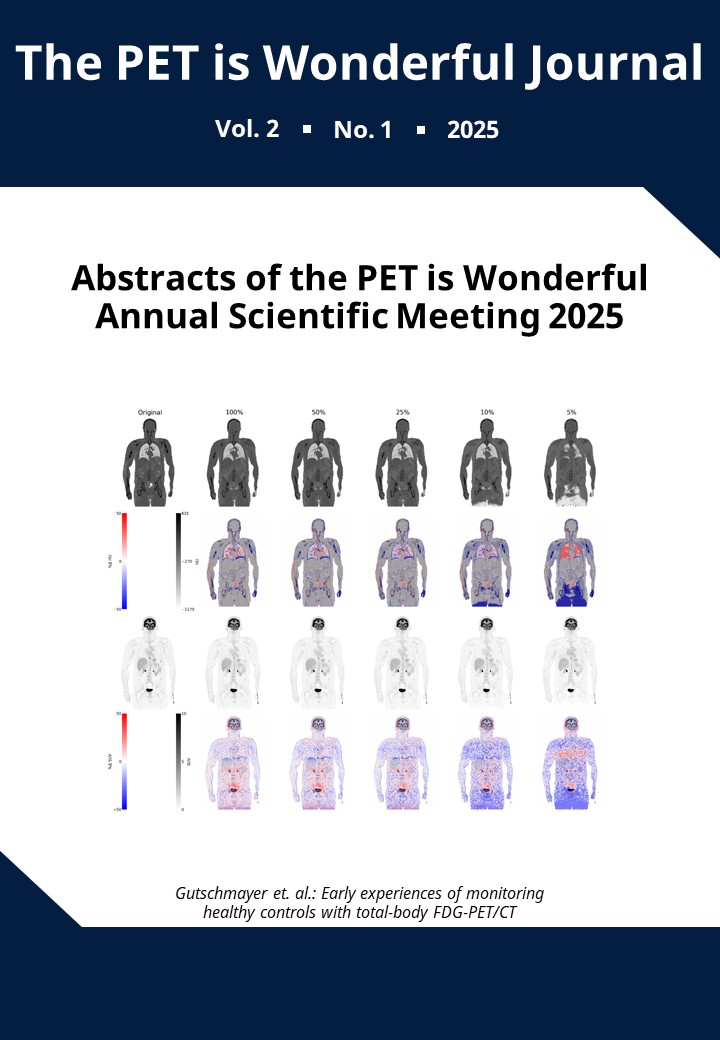
47 (25F/22M) participants underwent two 5-min TB-PET/CT scans (test/retest) on a Siemens Biograph Vision Quadra system following an injected activity of 100 MBq of FDG. Test and retest scans were ~35 days apart. MOOSE [1] was used for automatic organ delineation and extracting organ-specific readouts (HU, SUV, volume). Imaging repeatability was assessed by comparing test/retest readouts with % difference and Student's T-test per-subject and group levels, and with coefficients of variation (COV). To determine the lowest achievable PET-related radiation exposure, listmode emission data were reduced to 50%, 25%, 10%, and 5% of their original counts. Synthetic attenuation maps (ED=0 mSv) were used for attenuation correction at the various count levels [2] (Figure 1A). The %-differences of organ readouts between the reference and synthetic dose levels were statistically compared (Figure 1B).
For all assessed organs and readouts, test/retest %-differences were below 5% on a group level and 9% on a per-subject level, except in the heart and kidneys. Quantitatively accurate organ readouts were achieved at 25% of the original 100MBq (resulting in 0.5 mSv total ED) while preserving image integrity (COV < 15%).
Total-body FDG PET/CT provides reproducible measurements in healthy subjects and retains quantitative reliability at significantly lower doses, endorsing PET for longitudinal health monitoring and establishing metabolic references. Future work could integrate physiological and wearable data to expand this framework toward a broader model of systemic health tracking.
Please click on the 'PDF' for the full abstract!
Downloads
Published
Issue
Section
License
Copyright (c) 2025 Sebastian Gutschmayer, Daria Ferrara, Barbara Katharina Geist, Öykü Özer, Josef Yu, Manuel Pires, Ivo Rausch, Marcus Hacker, Lalith Kumar Shiyam Sundar, Werner Langsteger, Thomas Beyer

This work is licensed under a Creative Commons Attribution 4.0 International License.